The Minimum Wage, Wrongly Accused
First published in Le Nouvelliste on 17 April 2026. Read on lenouvelliste.com ↗
Translated from the French original. In case of discrepancy, the French text prevails. Read the French original
Since May 2025, the report of the Superior Council on Wages has been sitting on the executive’s desk. The women who work in the textile factories, whose pay scale has moved only once since February 2022, are waiting too. This column reopens the case against the minimum wage and shows where it misses the mark.
Since May 2025, the report of the Superior Council on Wages has been lying on the executive’s desk, with no decree to give it effect.1 The women and men who work in the textile sector, whose pay scale has changed only once since February 2022, are waiting. They take to the streets from time to time and are sometimes harshly repressed. And all the while, the public conversation circles, unchanging, around the same tired opposition.
On one side is what might be called the classical reading: a minimum wage set too high would destroy jobs and fuel inflation, because it would force firms either to lay off workers or to raise their prices to cover their costs. On the other is the Keynesian reading: without public support for the purchasing power of the most vulnerable households, demand collapses and drags the whole economy down with it. These two readings have been batting the ball back and forth in the Haitian debate for fifteen years. And each cycle of protest reproduces the same arguments, the same clashes, and the same outcome: a nominal adjustment chasing an inflation that has already set in, without ever catching up with it.
This opposition has the virtue of being easy to follow. It also has the drawback of largely missing the point. For some thirty years now, modern economic research has left this dichotomy behind and turned to more precise questions. What happens when an employer holds a near-monopoly over local labor and can therefore pay less than it should? What does it cost workers to look for another job, and how long must they accept being underpaid before they can leave? How far can a formal sector that is in the minority really impose a wage norm on an economy that is mostly informal? These are the questions that fit Haitian reality, and they are precisely the ones the local debate never reaches.2
This article aims to set the numbers straight. To proceed methodically, it is organized around six simple questions. Has the minimum wage scale really risen over the decade, or did it only appear to? To the extent that it has risen, is that increase responsible for the inflation everyone is enduring, as one often hears? If not, where does Haiti’s inflation come from? Why, in that case, has the debate been going round in circles for fifteen years? What should actually be done, and in what order? And finally, in the interest of honesty, what does this analysis not establish, and what therefore cannot be inferred from it? The text takes up these questions in that order. It draws on the monthly data available since 2014 and on a few econometric tests, which we will take the time to explain along the way.3
1. Has the minimum wage really gone up?
Answering this first question requires a simple but decisive distinction. When we talk about a wage, we can measure it in two ways. The nominal wage is the amount printed on the pay slip, in current gourdes. The real wage is what that amount can buy once rising prices are taken into account. If the wage goes from 100 to 150 gourdes while prices double over the same period, the worker is actually poorer than before, even though the nominal wage has risen by 50%. Any serious analysis of a wage over time must therefore make this correction. The Haitian debate, however, almost always speaks in current gourdes, which produces a permanent optical illusion.
The history of the textile minimum wage, that is, the one that applies to export assembly and is technically known as Segment A in the Superior Council on Wages’ classification, is a story of one-off adjustments. The so-called Benoît law set a floor of 200 gourdes a day in September 2009. Further adjustments followed at irregular intervals: 240 gourdes in April 2014, 350 in 2017, 420 in October 2018, 500 in November 2019, 685 in February 2022, and a recommended 1,000 gourdes for April 2025.4 As of the sources used in this article, this latest scale has not yet been made official by presidential decree: the wage actually paid in the factories remains 685 gourdes a day. The distinction between the recommended scale and the one actually in force matters, and it will come up several times in what follows.
What is this nominal increase worth once adjusted for inflation? Table 1 reconstructs the real wage from the monthly series of the general consumer price index published by the Haitian Institute of Statistics and Informatics (IHSI). The method is to set the January 2014 wage at 200 units, by convention, and then to recalculate, month by month, what the scale in force can buy relative to that starting point. A value of 100 units would mean that the real wage has been halved since 2014. A value of 200 would mean that its purchasing power has held steady. Anything in between measures a loss.
Table 1. Textile minimum wage (Segment A), in current gourdes and in constant purchasing power
| Date | Nominal MW (HTG/day) | Real MW (base 2014 = 200) | MW in USD/day | Inflation, y/y (%) |
|---|---|---|---|---|
| Jan. 2014 | 200 | 200.0 | 4.4 | 3.4 |
| Apr. 2014 | 240 | 232.5 | 5.2 | 3.5 |
| Jan. 2017 | 350 | 247.1 | 5.5 | 14.1 |
| Oct. 2018 | 420 | 222.6 | 5.5 | 14.3 |
| Nov. 2019 | 500 | 216.7 | 5.3 | 20.4 |
| Jan. 2022 | 500 | 156.2 | 4.4 | 24.0 |
| Feb. 2022 | 685 | 213.2 | 6.0 | 25.2 |
| Apr. 2025 (actual) | 685 | 86.4 | 5.2 | 27.1 |
| Apr. 2025 (recommended) | 1,000 | 126.2 | 7.6 | 27.1 |
| Dec. 2025 (actual) | 685 | 70.1 | 5.2 | 25.0 |
| Dec. 2025 (recommended) | 1,000 | 102.3 | 7.6 | 25.0 |
Sources: Superior Council on Wages (reports 1 to 8), IHSI (Coin de l’IPC, base 2017–2018 = 100), Bank of the Republic of Haiti (BRH). The “Real MW” column uses a CPI series rebuilt on a January 2014 = 100 base by chaining the year-on-year inflation rates published by the IHSI. No decree had been issued for the scale recommended for April 2025 at the time of writing. Author’s calculations.
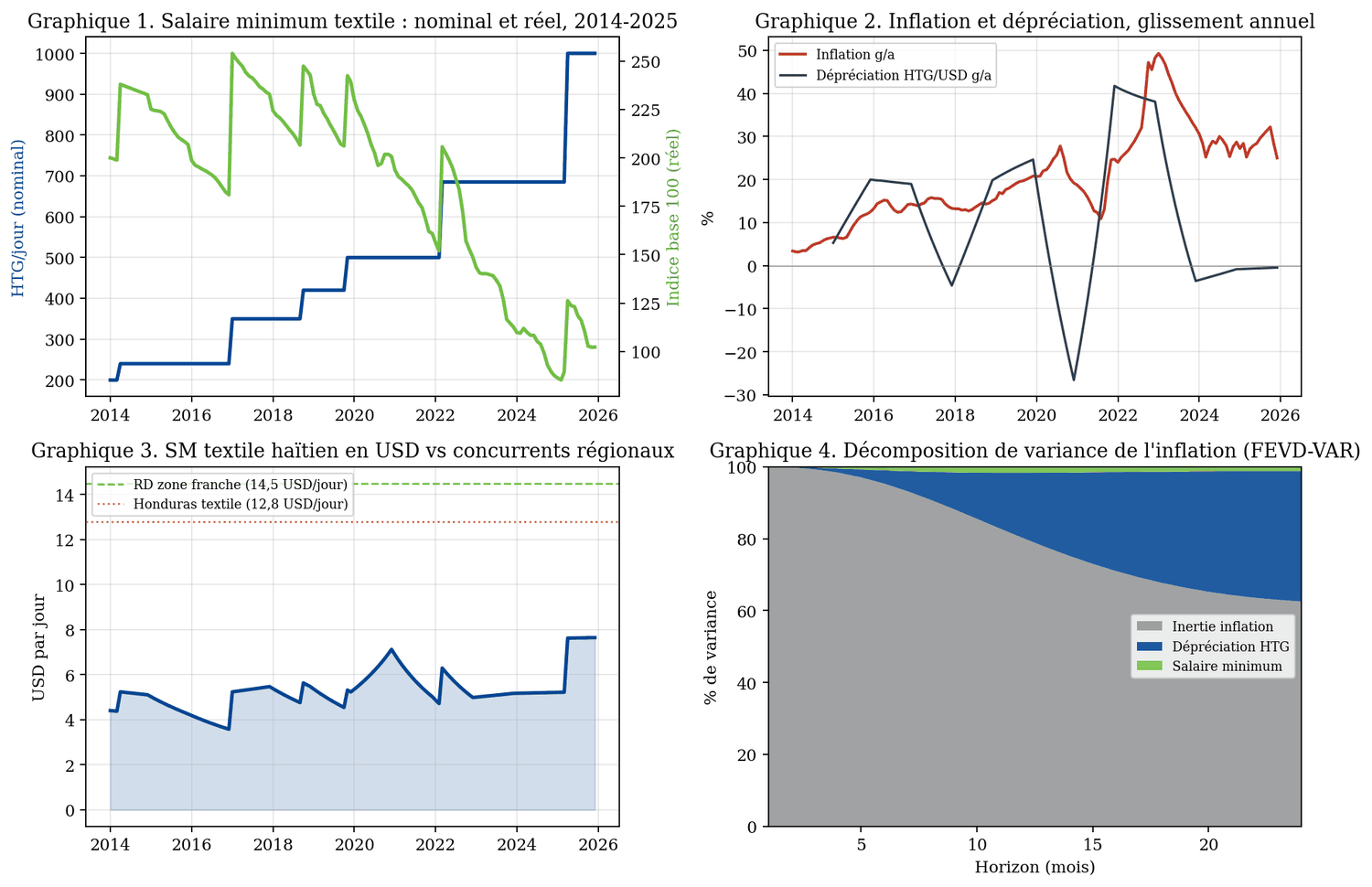
Sources: IHSI, BRH, Superior Council on Wages, national labor ministries. Author’s calculations.
The result is unequivocal. The real wage rises slightly after the 2014 adjustment, peaks around 2017 at 247 units, then declines steadily. On the eve of the February 2022 adjustment, it had fallen to 156 units. The move to 685 gourdes briefly restores purchasing power to 213 units, but the gain erodes at once under inflation that peaks at 48% in 2023. By the end of 2024, the real wage has fallen to 87 units, a 56% loss of purchasing power compared with 2014. If the recommended scale of 1,000 gourdes were applied, the real wage would temporarily climb back to 126 units in April 2025. Without it, it stays at 86 units. In the most favorable scenario, erosion resumes in the following months and the real wage ends 2025 at 102 units. The cumulative loss over the decade comes to 49% in this favorable scenario, and 57% if the 685-gourde scale remains in force.
That is the first answer, a factual one. The textile minimum wage has lost roughly half its purchasing power since 2014, even though it has been multiplied by five in current gourdes. If the erosion does not leap out in public discussion, it is because comparisons there are always made in current gourdes. Going from 685 to 1,000 gourdes would look like a substantial increase, 46% in nominal terms. But cumulative inflation between February 2022 and April 2025 is around 140%, depending on the estimation method used. Applying the recommended scale would thus make up only about a third of the loss. The 2025 scale, presented by some commentators as a social gain, would restore a fraction of purchasing power that was itself only a fraction of the 2009 level. Here, money illusion does all the rhetorical work.
2. Is this increase to blame for inflation?
If one accepts the previous finding, the question that takes up most of the public debate follows immediately: isn’t this wage, which is struggling to catch up with inflation, itself a major cause of that inflation? The argument is intuitive. When factories have to pay their workers more, they pass the increase on in their prices; those prices in turn feed into the household consumption basket, and households in turn demand a new wage adjustment. This is what is known as a wage-price spiral. The proposition is appealing. It does not stand up to an examination of Haiti’s monthly data.
To demonstrate this, I ran three independent tests, each based on a different logic. If the spiral hypothesis is true, all three should converge to confirm it. Instead, they converge to refute it.
First test: statistical regression
In simple terms, a regression is a calculation that measures the influence of several factors on a single variable while holding all the other factors constant. For our question, the variable to be explained is monthly inflation. The candidate factors are the depreciation of the gourde against the dollar, the change in the minimum wage, and the previous month’s inflation (which measures inertia, that is, the tendency of inflation to carry over from one month to the next).
Over 120 monthly observations covering 2015–2025, the regression concludes that the change in the minimum wage provides no statistically significant information for predicting inflation once the other two factors are taken into account. The joint test on the minimum wage coefficients at different lags (immediately, and three, six, and twelve months after the adjustment) gives a probability of 0.51 that the observed effects are simply due to chance. In statistics, an effect is considered credible when this probability falls below 5%. We are at 51%, ten times higher. In this regression, the minimum wage is as informative as a coin toss.
Two technical points are in order here. First, the chosen specification includes lagged inflation as an explanatory variable. This inclusion matches the precise question we are asking: does the minimum wage add any information beyond the internal dynamics of prices? One consequence is a very high coefficient of determination, 0.97, almost all of which comes from past inflation. Second, it is the coefficients on the exchange rate that come out as statistically credible. The depreciation of the gourde, whether contemporaneous or lagged, does indeed contain information for predicting future inflation.
Second test: Granger causality
The mathematician Clive Granger, winner of the 2003 Nobel Prize in Economics, proposed a simple test for detecting what can reasonably be called a cause-and-effect relationship between two series of figures over time. The idea is this: if A causes B, then A must precede B. Knowing the past of A should help predict B better than the past of B alone would. If this predictive improvement exists, A is said to Granger-cause B.
Applied to our series, the test yields two clear results. Past changes in the minimum wage do not help predict future inflation. The probability that the observed predictive improvement is due to chance comes out at 49% at a twelve-month horizon. Chance cannot be ruled out. Past depreciation of the exchange rate, on the other hand, does help predict future inflation, with a probability of false discovery of only 5%. The exchange rate passes the test; the minimum wage does not.
Third test: variance decomposition
The third test is a thought experiment with numbers attached. Suppose we are trying to predict inflation over the next two years. That inflation will vary, sometimes sharply, sometimes less so. The question is: what share of this variation comes from each of our factors? To measure it, we estimate a model that looks at all three variables at once (inflation, the exchange rate, the minimum wage) and lets them influence one another, then break down the forecast variance of inflation among the possible sources. Economists call this exercise a variance decomposition, and the model that produces it a vector autoregression, or VAR to the initiated.
Table 2. What drives the forecast variance of inflation at a 24-month horizon?
| Source | Share of forecast variance |
|---|---|
| Inflation’s own inertia (self-influence) | 62.5% |
| Exchange rate depreciation | 36.3% |
| Change in the minimum wage | 1.2% |
Source: VAR(2) model on monthly series, 2014–2025, lag length selected by the BIC. Author’s calculations using statsmodels.
The verdict is unambiguous. At a two-year horizon, 62.5% of the variance is explained by the internal dynamics of prices themselves. Exchange rate depreciation explains 36.3%. The minimum wage explains 1.2%. In other words, the exchange rate weighs thirty times more heavily than wages in shaping medium-term inflation. It is this stark hierarchy that definitively invalidates the thesis of a wage-price spiral as the engine of Haitian inflation.
A fourth, more technical model confirms this result from another angle. When one studies the long-run path of prices, the exchange rate, and wages, one finds that the three variables are bound by an equilibrium relationship that pulls them back whenever they stray from it. But this pull does not operate in every direction. It is prices that readjust to the exchange rate when the gap widens, never the reverse. The exchange rate is the “strong” variable in the system. The minimum wage adjusts as well, but this simply reflects the catch-up the authorities carry out after prices have moved, not a causal effect running from wages to inflation.
What these tests say, and what they do not
Let us be precise about what this set of tests establishes. It establishes that over the period observed, and conditional on the variables taken into account, changes in the minimum wage provide no statistical information for predicting inflation. It establishes that exchange rate depreciation, by contrast, provides information that is significant and economically important. It establishes that over the horizon on which public policy is designed, roughly two years, the exchange rate weighs thirty times more heavily than the minimum wage in price formation.
These tests do not say that the minimum wage has no effect on anything. They do not address, for example, the possibility that the scale pulls up wages just above the minimum, through a knock-on effect. Nor do they address the minimum wage’s possible effects on hiring, because we are working with a price equation, not an employment equation. Answering that question would require detailed factory-level data that the sector does not publish. These tests are equally silent on what would happen if the scale were multiplied by five or by ten in one go. Our observation period contains adjustments on the order of 30 to 50% at a time. Beyond that, we are extrapolating, and extrapolation is a risky exercise.
With these caveats, the finding holds. And it is reinforced by an argument of scale. In the favorable scenario where the recommended scale is applied, the total wage bill of the textile sector at the minimum wage comes to about 6.6 billion gourdes a year, or 0.6% of nominal GDP. At the actual wage of 685 gourdes, it falls to 0.4%. And this wage bill covers about 26,500 people, or 0.5% of the labor force as estimated by the World Bank and the International Labour Organization (ILO).5 To imagine that a wage signal affecting such a marginal fraction of the economy could single-handedly drive up the general price index is to turn the proportions upside down. It is like blaming a pebble for an avalanche.
3. So where does inflation come from?
If the minimum wage is not to blame, we still have to say what is. The simplest way to answer is to look at what, within the household consumption basket, accounts for the drift in prices. The Haitian Institute of Statistics and Informatics divides this basket into broad categories, called consumption divisions: food, housing, transport, clothing, restaurants, communication, recreation, miscellaneous goods and services. Each category has a weight in the basket (food accounts for half, housing and energy about 14%, and so on), and each category has its own inflation rate. A category’s contribution to overall inflation is its weight multiplied by its own inflation.
Table 3. Contribution of the main divisions to overall inflation, September 2025
| Division | Weight | Annual change | Share of inflation |
|---|---|---|---|
| Food and beverages | 50.6% | 35.1% | 52.2% |
| Housing, water, gas, electricity | 14.0% | 48.8% | 20.1% |
| Restaurants | 7.5% | 32.3% | 7.1% |
| Transport | 9.5% | 25.0% | 7.0% |
| Other divisions | 18.4% | 21-28% | 13.6% |
Sources: IHSI, Coin de l’IPC bulletin, September 2025. The weights used are estimates derived from the 2017–2018 Household Budget and Consumption Survey; the IHSI’s updated weights may differ slightly, which explains a gap of about 2 points between the sum of the reconstructed contributions and the published overall inflation rate. Author’s calculations.
Table 3 tells the essential story. In September 2025, 52% of overall inflation came from food and 20% from housing and energy. These two items alone account for nearly three-quarters of the drift in prices. Wages appear nowhere in this breakdown, because they do not enter the consumption basket directly. They enter it only indirectly, through the cost of labor in producing the goods consumed. And we have just seen that this channel is statistically negligible.
One important nuance should be added. Each month, the IHSI also publishes a further breakdown that distinguishes local products from imported ones. In September 2025, inflation for local products reached 34.1%, compared with 28.7% for imported products. For the first time in the recent period, goods made in Haiti are rising in price faster than those that come from abroad, despite a fairly moderate international environment. This reversal is explained by domestic logistics costs linked to insecurity, by breaks in national supply chains, by the informal ransoms levied along road corridors, and by the oligopolistic capture of distribution channels. It invalidates the mechanical reading according to which Haitian inflation is nothing more than inflation passively imported from abroad. A growing share of inflationary pressure is now generated at home, through market failure and logistical rents.
This point matters for the rest of the argument. If inflation came solely from the exchange rate and world markets, one could at least hope that monetary stabilization would be enough to contain it. If it now also comes from deteriorating conditions for transport and competition within the country, then ending the inflationary crisis requires a much broader agenda: road security, regulation of the margins of import oligopolies, strategic stockpiles of a few key products, effective control over goods entering through the main ports. None of these tasks can be settled by a wage decree.
4. Why does the debate go round in circles?
At this stage of the argument, two findings have been established. The minimum wage has lost half its purchasing power over the decade, and it is not what drives inflation. The next question almost asks itself: why, despite this evidence, does public debate keep replaying the same scene at short intervals? The answer, in my view, fits in a single sentence. The Haitian debate suffers from asking a single instrument to carry three burdens that share neither the same time frame nor the same levers.
The first burden is immediate purchasing power. The women workers who take to the streets are not defending a theory of growth or an industrial strategy. They are defending a real income that is collapsing at a historic pace. This emergency calls for fast-acting instruments: an adjustment in line with observed inflation, cash transfers targeted at the households most exposed to food insecurity, and time-limited subsidies on a few basic necessities, whose list ought to be drawn up on the basis of consumption surveys rather than discretionary political trade-offs. The minimum wage has a place in this toolkit, but it cannot be the only tool in it, if only because its actual coverage is limited to a small fraction of formal employment.
The second burden is labor productivity, that is, the value that Haitian labor actually manages to create. This is where those who denounce the assembly industry as a dead end have a sound intuition. Haiti’s specialization in cut-make-trim production, that is, assembling garments from fabrics, designs, and brands supplied by others, has locked local industry into the least lucrative segment of the global textile chain. Of every $100 of clothing exported from Haiti, only about $20 pays Haitian factors of production (labor, local capital, taxes). The rest covers the cost of imported inputs and the margins captured upstream and downstream by other players. In comparable countries such as Bangladesh or Ethiopia, this share of local value added reaches 40 to 60%.6 The difference is far from trivial: in the long run, it is what sets the ceiling on the wages Haitian factories can pay.
Moving Haitian textiles upmarket requires a coherent package: design schools, effective protection of intellectual property, medium-term financing instruments, stable access to energy, secure logistics corridors. None of these projects is making significant headway today. The regional comparison is telling: at $7.6 a day for the recommended wage, and only $5.2 for the wage actually paid, Haiti’s textile minimum wage is one of the lowest in the Caribbean and Central America.7 The Dominican Republic pays about $13.9 a day in its free zones, Honduras $12.8, Guatemala $13.8. Yet this wage compression did not prevent employment from collapsing over the same period: from about 62,000 in 2021 to 26,500 at the end of 2024, according to Better Work Haiti. Competitiveness is not won in a race to the bottom. Recent history proves the point in the negative.
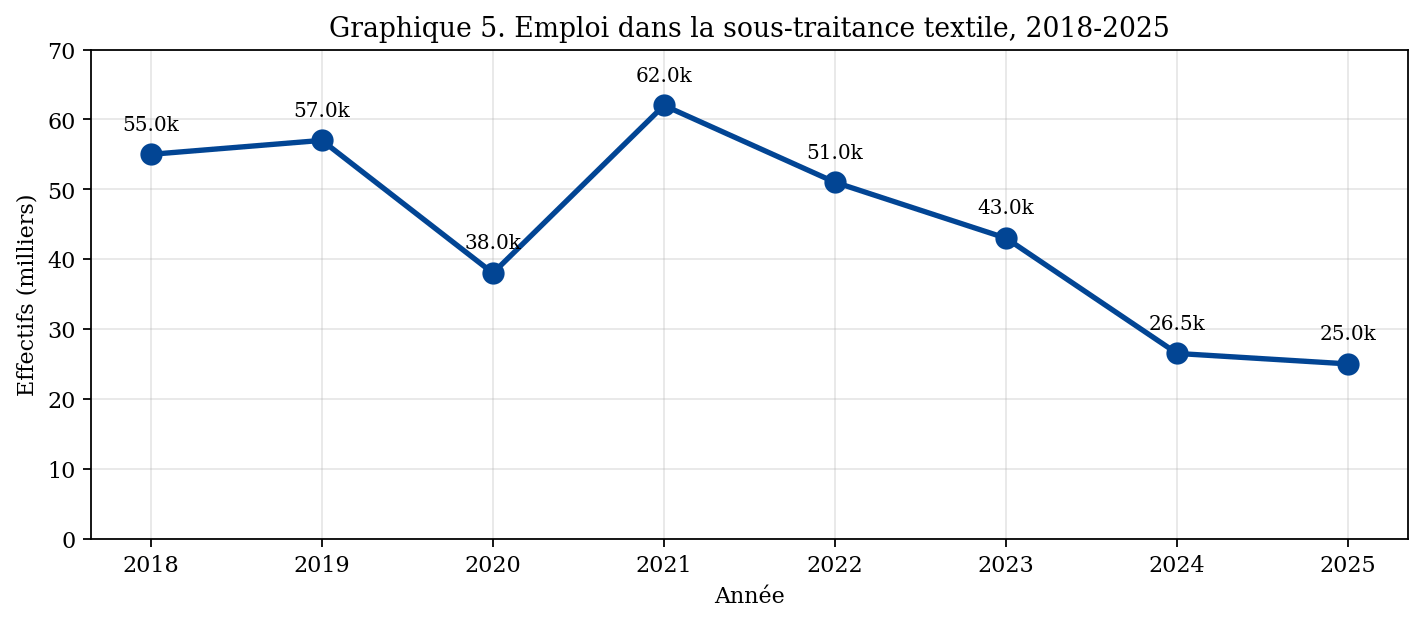
Source: Better Work Haiti, semiannual reports, 2018–2025. Compiled by the author.
The third burden is labor market institutions, that is, the whole set of rules, bodies, and instruments that allow a wage policy to have a real effect on the ground. The Superior Council on Wages, which ought to be the tripartite forum for negotiation, meets irregularly, submits its reports late, and sometimes sees its recommendations put on hold for months, as 2025 clearly shows. Minimum wage coverage in the real economy, beyond the few formal pockets of the civil service, the banking sector, and the assembly industry, remains largely theoretical. The Labor Code provides for protection mechanisms that neither the labor inspectorate nor the trial courts have the means to enforce. Social security, through the old-age insurance office (ONA) and the work-injury, sickness, and maternity insurance office (OFATMA), reaches only a narrow circle, with marginal coverage rates in the informal sector, where most employment is concentrated. Unless this institutional ecosystem is rebuilt, the minimum wage remains a signal with nothing to relay it, a norm whose reach shrinks as informality spreads.
That is why the debate goes round in circles. By loading these three burdens onto a single instrument, we manufacture a quarrel in which neither camp is wrong on its own terms, yet both are talking about something other than what the instrument can actually deliver. Advocates of a substantial adjustment are right about the social emergency but overestimate what the wage scale alone can achieve. Opponents of any increase are right about the instrument’s modest reach but wrongly conclude that it is therefore better left alone. The trap lies in how the discussion is framed, not in the positions of those taking part.
5. What should actually be done?
A few recommendations follow from this analysis, with no claim to completeness. None is new in principle; how they fit together, however, determines whether they work.
First, establish a mechanism that automatically indexes the minimum wage to observed inflation. In practice, this would mean that at the start of each year, the scale would be recalculated mechanically from the average of the inflation rates published by the IHSI over the previous twelve months, with no need for a discretionary decision. Such a mechanism would strip each cycle of its political explosiveness. It would turn a decision negotiated through confrontation into a technical rule, predictable for employers and workers alike. A review clause every two years would allow a possible catch-up of lost purchasing power to be discussed without calling the indexation mechanism itself into question.
Next, explicitly separate wage policy from income support policy. A sizable share of the support for the purchasing power of the poorest households will never pass through the minimum wage, simply because these households work in the informal economy or are self-employed. Reaching them requires other instruments: conditional cash transfers, that is, payments made in return for keeping children in school or taking an infant for regular health checks; expanded school meal programs; targeted subsidies on residential electricity for the first kilowatt-hours consumed. The budgetary cost of such schemes is not negligible, but it remains far lower than the cumulative economic cost of the current collapse in purchasing power, which is showing up as mass emigration and a lasting contraction of domestic demand.
On the industrial front, accept that the solution does not lie in textiles alone, nor in some miraculous move upmarket by the existing assembly industry. Higher-value-added segments are built through a long accumulation of capabilities, not by decree. From this perspective, the state’s role is less that of a planner than that of a patient co-investor and a serious regulator. In particular, it should reconsider the tax regime for free zones, which today rewards volume at the expense of local value added, and attach to it measurable obligations in training and technology transfer.
Finally, and above all, treat the exchange rate and domestic supply chains as the real variables of anti-inflation policy. Depreciation explains 36% of the forecast variance of inflation at a two-year horizon, and the breakdown by division shows that the missing third lies in domestic failures more than in imported shocks. Until this hierarchy is recognized, no wage policy will be able to restore purchasing power for good. What matters is the order of priorities: stabilize the exchange rate and secure the roads first, then adjust the scale automatically, support the incomes of informal households in parallel, and rebuild industrial capacity over the longer term.
6. What this analysis does not say
Every economic analysis rests on assumptions, and every conclusion holds only within the limits of what has actually been measured. It is important to state them clearly, both out of intellectual integrity and because the recommendations above are prudent only if one is willing to set bounds on what they presuppose.
The monthly inflation series was reconstructed from IHSI publications for 2014–2025, giving 144 observations. That is enough for standard econometric tests, but short for pinning down effects that would ideally require several complete cycles. The price index series in levels, used to calculate the real wage, is itself a reconstruction, obtained by chaining the published year-on-year inflation rates from an anchor point in January 2014. It may therefore diverge slightly from the official CPI published by the IHSI with 2017–2018 = 100. The monthly exchange rate series was interpolated from annual data points published by the Bank of the Republic of Haiti, which smooths out a highly volatile variable and may understate very short-term pass-through. The steps in the minimum wage, which are by nature discrete and infrequent, also create an identification problem: changes in the scale are rare and bunched together in time, which makes it harder to measure their specific effect. A proponent of the inflationary hypothesis can always object that our coefficients poorly capture an effect that is real but discontinuous. The objection is not absurd, but it cannot be used to support the opposite hypothesis, namely a massive inflationary effect that the data would have missed.
The analysis concerns inflation, that is, prices. It does not concern employment. That the minimum wage does not fuel rising prices does not mean it has no effect on hiring in the formal sector it covers. The question is real and calls for other data, microeconomic this time, which neither the assembly factories nor the government publish. All we can say is that the massive contraction in textile employment in the recent period, from 62,000 to 26,500, occurred while the wage scale was stable. That invites us to look for the causes somewhere other than in wage trends: the security crisis, uncertainty over the renewal of US trade preferences, logistical disruption.
The adjustments observed in our data stay within a moderate range, on the order of 30 to 50% at a time. The analysis says nothing about what would happen if the minimum wage were abruptly doubled or tripled. A reform on that scale would fall outside the observed ranges, and its effects cannot be mechanically inferred from our regressions. Prudence requires saying so.
Finally, an additional test comparing the behavior of the series before and after January 2020 suggests that exchange rate pass-through to prices has intensified in the recent period, rising from about 3% to 7% in the short run. This shift is significant at the 10% level (p = 0.09) but does not reach the conventional 5% threshold. It deserves watching. It does not weaken the article’s main finding. Rather, it suggests that the transmission of shocks intensified during the phase of institutional weakening, which, paradoxically, strengthens the case for treating the exchange rate and domestic markets as the priority.
At the end of this journey, the essentials can be stated in a few words. For fifteen years, Haiti’s minimum wage debate has consumed considerable energy to produce marginal results. The adjustments wrested at the cost of protests that were sometimes bloody are not enough to offset the real erosion, which amounts to nearly half of purchasing power over the past decade in the most favorable scenario, and more still if the 685-gourde scale remains in force. The arguments against adjustment, based on the fear of an inflationary spiral, do not withstand the empirical examination carried out here, within the limits of what that examination can establish. And the quarrel recurs, unchanged, at short intervals, without any of the three underlying questions (purchasing power, productivity, and institutions) receiving the specific treatment it would call for.
Restoring the minimum wage to its proper function, which is to protect the floor of pay for formal work and to signal a social norm, requires rebuilding the other parts of the system at the same time. That is a program. It is not a slogan. Its drawback is that it cannot be reduced to a formula, which is probably why it struggles to emerge in a public conversation shaped by the emergencies of the social calendar. But unless that work begins, the country will go on replaying the same scene every year, with the same actors, the same arguments, and the same silent outcome: a minimum wage that loses a little more of its substance, and an economy that sinks a little deeper into a stagflation from which it no longer knows how to recover.
Notes and sources
1. Superior Council on Wages, Huitième rapport sur la fixation des salaires minima par secteurs d’activités, Port-au-Prince, May 2025. The recommended scale sets Segment A at 1,000 HTG/day as of April 2025. As of the latest sources used in this article, no presidential decree has made it official; see Centrale autonome des travailleurs haïtiens, statement carried by AlterPresse, 20 September 2025.
2. David Card and Alan Krueger, “Minimum Wages and Employment: A Case Study of the Fast-Food Industry in New Jersey and Pennsylvania,” American Economic Review, 84(4), 1994. For a recent survey, see Alan Manning, “The Elusive Employment Effects of the Minimum Wage,” Journal of Economic Perspectives, 35(1), 2021.
3. All the monthly series used come from the Coin de l’IPC (IHSI), BRH publications, and the reports of the Superior Council on Wages. Textile employment: Better Work Haiti / ILO. Consistency checked against IMF, Country Report 25/19, January 2025. The full methodology, the choices made in reconstructing the series, and the limits of the estimates are discussed at the end of the article.
4. Law of 6 October 2009 setting the minimum wage, Le Moniteur, 164th year, no. 92. For the full chronology of successive decrees: Sonel Volmar, “Petite histoire du salaire minimum de 1934 à 2022,” HDIT Cabinet Volmar, May 2022.
5. Textile employment: 26,500 at the end of 2024, according to Better Work Haiti. Labor force: World Bank and ILO projection for 2024, predating the massive internal displacement and emigration documented since 2023, which have probably shrunk the labor force, though no updated public estimate is available. Nominal GDP for 2023–2024: approximately HTG 1,100 billion (IHSI, Comptes économiques 2024).
6. Center for Global Development, “Haiti’s Apparel Sector and the Search for Higher Value Added,” policy paper, 2016. It estimates the share of domestic value added in Haiti’s textile exports at about 20%, compared with 40 to 60% for regional comparators such as Bangladesh or Ethiopia.
7. Haitian textile employment: Better Work Haiti, semiannual reports, 2018–2025. Regional comparison: national labor ministries, 2025 (Resolución CNS 02/2024 for the Dominican Republic, Acuerdo Ejecutivo STSS-001-2025 for Honduras, equivalent scales for El Salvador, Guatemala, and Nicaragua). Converted to USD at average 2025 rates, on the basis of 22 working days a month.