The Unplugged Barometer: What the Dollar’s Stability Really Means
First published in Le Nouvelliste on 19 May 2026. Read on lenouvelliste.com ↗
Translated from the French original. In case of discrepancy, the French text prevails. Read the French original
For years, the health of Haiti’s economy was read in the price of the dollar posted by the money changers, rather than in the public accounts or the production statistics. This column explains what the recent stability of that price means, and why the barometer is now unplugged.
For years, the exchange rate was the barometer of national anxiety. People did not read the health of the economy in the public accounts or in the production statistics; they read it in the price of the dollar, posted by the money changers, talked over on public transport, dreaded at the end of every month. When it rose, the whole country knew before any official indicator came out. Anxiety could be gauged by the voices of those who used the dollar, of traders, of families receiving remittances, of everyone for whom the gourde, as it depreciated, melted away in their hands. And the demand rising from every quarter was a single one: that this currency finally be stabilized, this currency that had become, for want of anything better, the store of value of a country that had no other.
That stabilization has come. For almost two years now, the dollar has not left a very narrow band. It still moves, but barely, by a few centimes around 131 gourdes, where it once jumped by several gourdes in a matter of weeks. Its range has been squeezed so flat that the barometer everyone used to watch seems frozen, and this near-stillness is read, almost everywhere, as the good news we had been waiting for. This is precisely where we need to stop and face an uncomfortable question. Is it not a contradiction to celebrate exchange-rate stability today after having been so alarmed by its instability? The objection is legitimate, and it must be answered before anything else, or nothing that follows deserves to be read. The answer is that the exchange rate has not changed in nature between yesterday and today. What has changed is the way we look at it. Yesterday we read its rise as an alarm signal, and we were right, because it was one. Today we read its calm as a sign that things are back to normal, and that, perhaps, is where we are wrong. For the country is not doing better. It is doing worse. An instrument that says all is well in a country that is getting worse is not a reassuring instrument. It is an instrument that needs to be examined.
This piece is that examination. It will not argue that stability is a bad thing, and it will accuse no one. It will show, with the data to back it up, why the relief we feel at this unmoving figure deserves to be questioned, and what it conceals. The argument follows a single thread. First, understand what a price really is and why a living market is never entirely calm. Next, look at what the Haitian data say when set against those of the neighboring countries. Finally, measure what the mechanism holding this rate in place costs, and who pays the price. Each step prepares the next.
I. What a price is for
The deeper function of a price, the one that justifies having markets at all, is not to indicate what something costs. It is to carry information between people who do not talk to one another. A rice importer knows that the next order will be bigger. An exporter knows that the harvest will be poor. A bank knows that a client is about to repatriate funds. A mother in Carrefour notices that her son’s transfer has shrunk. Each of them holds a fragment of information about the real supply of and demand for foreign currency, and no one holds the full picture.
When the importer buys dollars ahead of time, the order pushes the rate up ever so slightly. That movement tells everyone else, without their knowing why, that pressure is building. The price becomes a living display board on which, trade after trade, the sum of what each person knows separately is written. In 1945 Friedrich Hayek put it in the words that remain the most accurate: a price is a system for transmitting information. Its function is not to reflect some hidden value; it is to allow people who do not know one another, and who do not coordinate, to act as if they were acting in concert. Let us hold on to this, because everything follows from it. A price that moves is information circulating. A price that no longer moves is information that no longer circulates, or that now travels through a channel other than the market.
II. Why a living market is never perfectly calm
Here is the point that turns the common reading on its head. We tend to believe that a good market is a calm market. Economic theory shows the opposite, and the reasoning is worth following step by step. Imagine a market in which the price instantly reflected all available information, a perfectly transparent market. In that world, gathering information would be pointless: reading the price would tell you everything, for free. But if no one thinks it worthwhile to gather information any more, then no one brings information to the market through their trades. And a price that no information feeds any longer reflects nothing at all. The perfectly informed market therefore destroys itself. Sanford Grossman and Joseph Stiglitz formalized this paradox in 1980: a perfectly efficient market is impossible. For a market to stay alive, it needs a little disorder at all times, what economists call noise, which leaves the best-informed a reason to keep informing themselves.
The consequence is inescapable. A degree of volatility is not a market’s illness; it is its breathing. A rate that moves a little every day is a rate into which information keeps flowing. A rate whose movement tends toward zero is a rate into which information has stopped flowing, or else a rate cut off from the mechanism that used to feed it. Perfect flatness is not a sign of health. It is a symptom whose origin must be established, and that is the subject of what follows.
III. The fact, seen in its regional setting
Flatness cannot be judged in the absolute, only by comparison. The right question is not whether the Haitian rate is stable, but whether it is stable to a degree that comparable economies do not reach. The Bank of the Republic of Haiti (BRH), the central bank, publishes the average buying rate every business day. Over fiscal year 2024–2025, that comes to 245 quotations, all within a band of 1.67 gourdes, which works out to an annualized volatility of just over 1%.
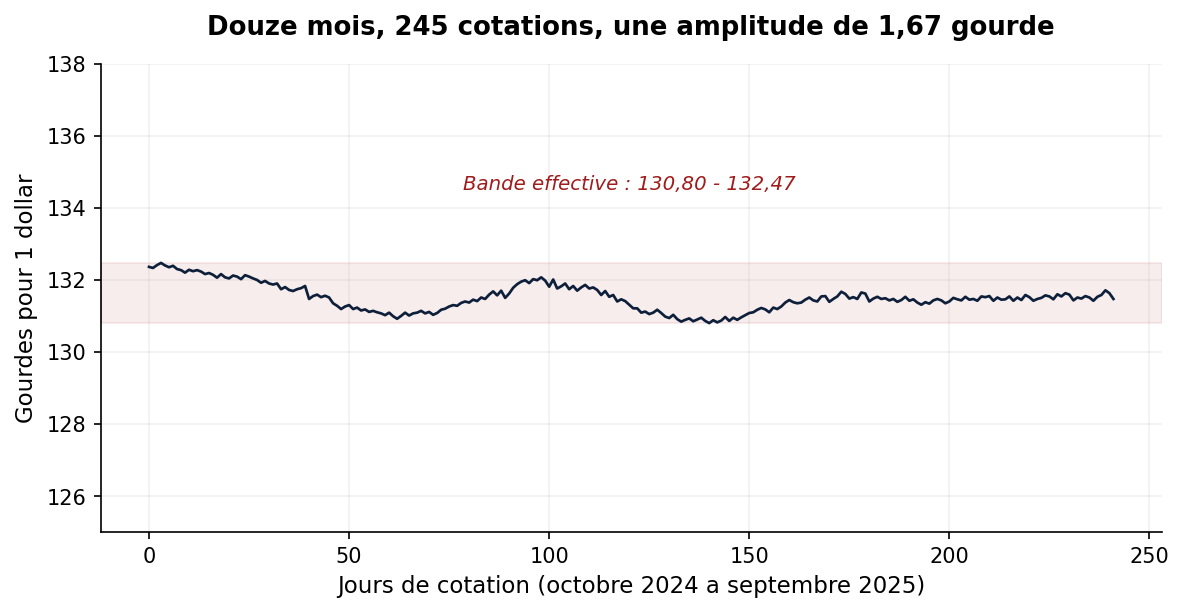
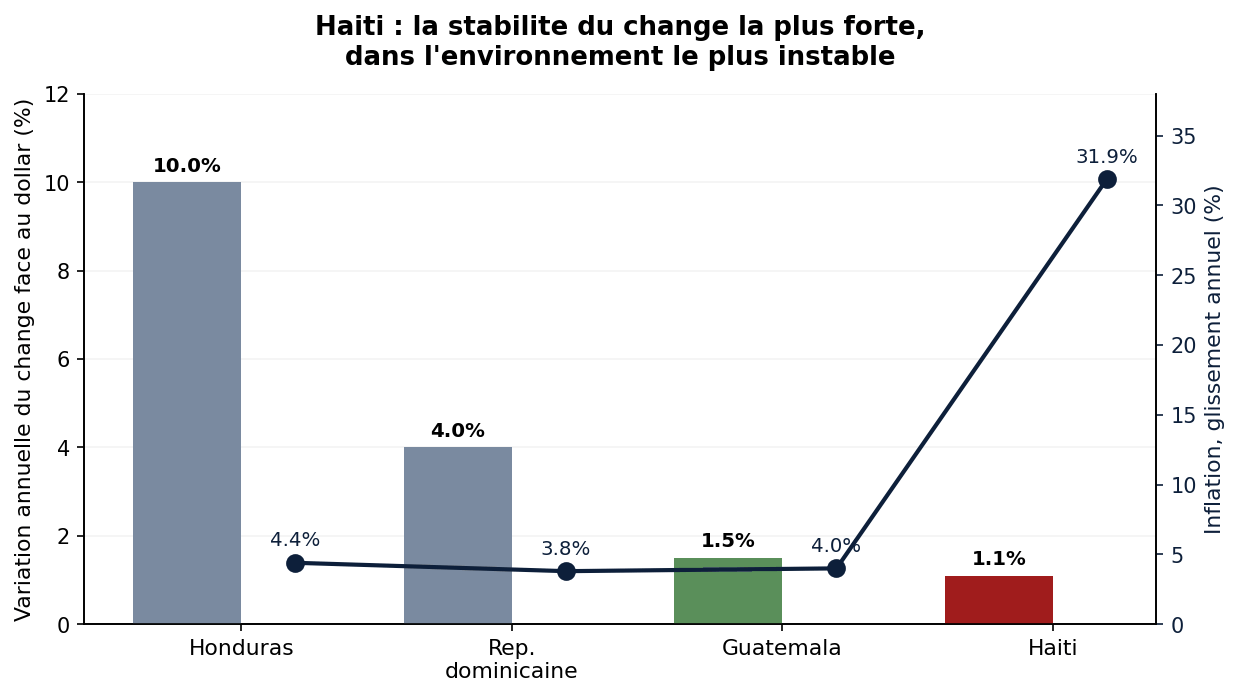
This figure takes on its meaning once it is set against the immediate neighbors, economies that also depend heavily on remittances. The US Treasury’s official exchange-rate reports, a neutral and consistent source, allow a comparison over the same period.
| Country (high-remittance economy) | Annual exchange-rate change | Inflation, y/y | Regime |
|---|---|---|---|
| Honduras (lempira) | ≈ 10% | 4.4% | Crawling band |
| Dominican Rep. (peso) | ≈ 4% | 3.8% | Managed float |
| Guatemala (quetzal) | ≈ 1.5% | 4.0% | Managed float |
| Haiti (gourde) | ≈ 1.1% | 31.9% | De jure float |
Sources: US Treasury Reporting Rates of Exchange (Dec. 2024, June and Sept. 2025); IMF Country Report, Honduras 2025; central banks; Haitian Institute of Statistics and Informatics (IHSI) for Haitian inflation.
The last column deserves a word, because it holds the key to everything that follows. Officially, since the liberalization of 1990, the gourde has been declared a floating currency: no legal text sets its value, and that is why the table places it among the de jure floating regimes. But what a country declares and what it practices are two different things. A regime can float on paper and be held in place in practice. The question, then, is not what the regime announces, but what the rate actually does. That is precisely what the rest of this piece examines.
The table already says a great deal, but a picture says it better.
IV. What is known, and what is not
A rigorous reader will object, and rightly so, that a flat rate can be the sign of a market that works very well. If the underlying forces that determine the exchange rate, the supply of foreign currency and the demand for it, are themselves stable, then a price with little volatility is the correct response of a healthy market, not a symptom. This is the most serious objection that can be raised, and it must be answered formally, not rhetorically.
Let us set two hypotheses against each other. The first: the Haitian rate is flat because its fundamentals are stable and the market faithfully reflects them. The second: the rate is flat because it is being held, despite unstable fundamentals. Guatemala provides the decisive test, because it embodies precisely the first hypothesis. Its quetzal moves little, about 1.5% a year, and legitimately so: inflation around 4%, foreign exchange reserves covering several months of imports, low deposit dollarization, positive growth. In Guatemala, exchange-rate calm is endogenous. It flows from fundamentals that are themselves calm. This is a healthy market whose quiet price tells the truth about a quiet environment.
Haiti presents exactly the opposite configuration beneath a comparable flatness. Inflation at 31.9%, eight times Guatemala’s. A seventh consecutive year of recession. Deposit dollarization of between 64 and 70%. Remittances swinging by plus or minus 20% from one year to the next. The fundamentals are not stable; they are among the most unstable in the hemisphere. Yet a determined variable cannot be structurally more stable than the forces that determine it, unless an intervention keeps it there. The contrast between Haiti and Guatemala is therefore no coincidence: it is the refutation of the first hypothesis. Where the fundamentals are calm, the exchange rate is calm by nature. Where the fundamentals are raging and the exchange rate stays calm, the calm is manufactured. The first hypothesis is eliminated not by argument, but by a structural counterexample.
A clarification is in order here, because it heads off a misunderstanding about the very subject of this piece. That Haiti’s exchange rate regime is semi-managed is no secret to anyone. The monetary authority does not hide it, market operators know it, and no serious person claims that the gourde floats freely. To demonstrate at length that the rate is held would therefore be to prove the obvious. That is not the point. That the rate is pulled back toward its target is accepted, and it is in any case easy to verify: the rate’s tendency to return to the previous day’s value is strongly marked, and this property withstands every serious econometric test that can be applied to it, from the Lo and MacKinlay variance ratio to GARCH-type conditional volatility models, ARMA models, seasonal specifications, and threshold models with Hansen’s linearity test. This apparatus is not the heart of the argument. It is a defensive weapon, to be drawn only if someone came along claiming the opposite, namely that this calm is that of a free market that has found its equilibrium. To that person, and to that person alone, we answer with a measure that is robust to everything. For everyone else, the fact that the rate is held is a starting point, not a conclusion.
The real question, the one that public debate never takes up, begins exactly where what is known ends. Everyone knows that the exchange rate is managed. No one says what this management has done to the rate, what it costs, or who pays for it. That, and that alone, is what the rest of this piece establishes. A held rate is not merely a guided rate: it is a rate that has stopped performing the function for which a price exists, transmitting information. And holding it is not free: it is financed through a monetary mechanism whose cost can be put in figures and whose payer has a face. The rest of this piece does not seek to prove that the rate is held. It starts from that accepted fact to show what it conceals.
V. Two sides of the same coin
Before establishing the cost, we must clear up a confusion that runs through the entire public debate. People speak of the stability of the currency as if it were a single quantity. There are two, and they are distinct; confusing them is precisely what makes the situation so hard to read. A currency has an external value: what it is worth against other currencies, which the exchange rate measures. It also has an internal value: what it can buy at home, which falls exactly as prices rise. The first tells us what the gourde is worth abroad. The second tells us what it is worth at the market in Port-au-Prince. These are two separate things, and a currency can perfectly well hold on to one while losing the other.
That is exactly the Haitian case. The gourde’s external value is being held: the dollar stays at 131 gourdes. The gourde’s internal value is collapsing: prices are rising by nearly a third a year, so what the same gourde buys in Port-au-Prince shrinks accordingly. These two facts do not contradict each other, and they do not coexist by chance. They are bound by a relationship of cause and effect that the rest of this piece demonstrates, and that can be stated plainly at the outset: the stability of the external value is not something that happens alongside the erosion of the internal value; it is achieved through it. Holding the exchange rate requires issuing money, and the money issued is what destroys domestic purchasing power. The title of this piece is therefore not a rhetorical antithesis. It is the statement of a mechanism: the dollar is stable because the plate is emptying. Demonstrating that “because” takes up the rest of the analysis.
VI. The accounting chain: what holding a rate costs
Here the analysis stops being theoretical and becomes strictly a matter of accounting. It now draws only on identities and on records published by the central bank. If a rate is held, some hand is absorbing the imbalances. In an economy where foreign currency pours in through remittances, the surplus of dollars should push the rate down. To prevent that, the surplus has to be bought up. The Foreign Exchange Department’s record of interventions shows that the central bank did just that, through sustained net purchases throughout the fiscal year.
Buying dollars means paying in gourdes, and therefore issuing them. According to the Foreign Exchange Department’s record, the central bank bought $600 million on the market over the fiscal year and sold $22 million, for net purchases of $578 million. At the average rate for the period, that represents an injection of primary liquidity on the order of 76 billion gourdes. These purchases are not smoothed out: three months account for more than half of them, which is the hallmark of active steering rather than passive adjustment.
Then comes the objection that any central banker will raise, and it must be met head-on. The central bank has instruments for mopping up the liquidity it injects: its 7-, 28-, and 91-day bills, placed with the commercial banks. If it sterilized all of its foreign currency purchases in this way, the monetary base would not grow, and the central link in this reasoning would give way. The record of BRH bills, published by the Credit Control Directorate, shows that their outstanding stock went from 21.6 to 22.5 billion gourdes over the same fiscal year. It rose by only 0.9 billion. Set against the 76 billion injected, the sterilization rate comes out at around 1%. Ninety-nine percent of the liquidity created to hold the exchange rate was not mopped up, and setting the two official records side by side, the interventions and the bills, shows each confirming the other.
Comparing these two figures is not even essential. Sterilization, by definition, neutralizes the effect of foreign currency purchases on the quantity of money. Had it been complete, monetary expansion would have been contained. It was not: the monetary base grew by more than a fifth over the period. That growth is, by accounting construction, the trace of what was not sterilized. The objection about the bills therefore does not break the link; it gives its measure: sterilization did exist, it remained marginal, and the liquidity left in circulation is what feeds inflation.
| Link in the chain (billions of gourdes unless otherwise stated) | Start / ref. | End / value | Change |
|---|---|---|---|
| 1. BRH net foreign currency purchases, FY 24–25 (the absorption, measured) | (flow) | $578M | ≈ 76 bn gourdes |
| 2. Outstanding BRH bills, change over the fiscal year (the sterilization) | 21.6 | 22.5 | +0.9 (≈ 1%) |
| 3. Monetary base (the gourdes issued in return) | 429.5 | 522.2 | +21.6% |
| 4. Broad money, M3 (the diffusion) | 656.6 | 767.1 | +16.8% |
| 5. Credit to the private sector (what shrinks) | 165.7 | 148.9 | −10.1% |
| 6. Year-on-year inflation (%) | 26.7 | 31.9 | +5.2 pts |
Sources: record of foreign exchange market interventions, BRH Foreign Exchange Department (DAI), FY 24–25; record of BRH bills, Credit Control Directorate; components and counterparts of M3; consolidated balance sheet of the commercial banks, BRH.
More money chasing an output that has been shrinking for seven years has a name: inflation. And inflation is a levy. Anyone who holds the national currency sees their purchasing power eroded accordingly. Economists call this the inflation tax:
Inflation tax = inflation rate × money held in gourdes
The calculation, set out term by term, can be checked by anyone with access to the public series.
| The inflation tax calculation, term by term | Value (Sept. 2025) |
|---|---|
| Money held in gourdes (M2 aggregate) | 389.2 billion gourdes |
| Year-on-year inflation rate | 31.9% |
| Tax = M2 × inflation | 124.1 billion gourdes |
| Converted at the average rate (131.5 HTG/USD) | $944 million |
| For reference: annual remittances (2025) | ≈ $5,000 million |
| Tax as a share of remittances | ≈ 19% |
| For reference: exports (fiscal year) | ≈ $520 million |
Sources: M2 aggregate (components of M3), IHSI price index, BRH statements on remittances, foreign trade statistics.
Let us run through the chain in one go, since its strength lies in the fact that every link is an identity or an official record. The rate is pulled back toward its previous value, as autoregressive estimation robustly establishes, and the regional counterfactual makes it very hard to attribute this to stable fundamentals, since they are, on the contrary, among the most unstable in the hemisphere. That the rate is held can be read directly in the record of interventions: $578 million in net purchases over the fiscal year. Absorbing means issuing gourdes, and the record of bills shows that only one percent of that issuance was mopped up. A money supply growing faster than output feeds inflation, as the price series attest. Inflation is a tax on holders of gourdes, as the arithmetic demonstrates. Honesty requires one caveat: part of Haiti’s inflation is non-monetary in origin, linked to supply chains and to insecurity. The amount of the tax is therefore an upper bound on the cost strictly attributable to stabilization, not an exact figure. This caveat does not weaken the chain; it marks out its scope precisely.
VII. What this diagnosis adds, and what it is not
The evidence is in place. What remains is to say precisely what it establishes that is new, and above all what it does not allow us to conclude, because the line between the two is exactly what separates an analysis from an indictment. Since Calvo and Reinhart, the literature has recognized the tendency of emerging economies to stabilize their exchange rates while declaring a floating regime, which they called fear of floating. Since the work on financial dollarization, it has recognized the constraints that dollarization imposes on monetary policy. The present analysis does not rehearse these established findings. It proposes a distinction. A managed float describes a market that works but is being steered. What is documented here is different: in the limiting case of a very shallow, highly concentrated market subject to extremely unstable fundamentals, the stability observed is not a guided float; it is the extinction of the price’s informational function. The rate no longer reports the state of the market, because it no longer measures it. This is not a variant of fear of floating; it is a distinct category, which might be called flatness without price discovery.
One must be absolutely precise about what this analysis does not claim. It does not say that any institution got it wrong. Maintaining stability in an economy this dollarized, where a depreciation would pass straight through to prices and balance sheets, is a defensible trade-off between two evils, and the analysis calls for no other policy. It points the finger at no one, because there is no fault in this story; there is a mechanism. What it establishes is more precise and more unsettling: the word stability, applied to this rate, masks two simultaneous facts. That the rate no longer performs its function as a signal, which the rate’s behavior and the regional counterfactual establish together. And that holding it in place has a price, which monetary accounting puts a figure on. To read flatness as a cost-free success is to mistake an unplugged thermometer for a cured patient, and to forget that keeping the needle in place has taken real spending, borne by those who have nothing but gourdes in hand.
VIII. The unplugged barometer
One last step remains, and it is perhaps the only one that touches people directly. Everything above establishes that the rate no longer says anything. But a price that no longer says anything is not perceived as silent. It is perceived as reassuring. This is where the question stops being technical and becomes human.
Let us now return to the image with which this piece began, the barometer. It was not a figure of speech; it was the heart of the problem, and it is time to call it what it is. During the years of instability, the reflex of reading the rate to know where the country was heading took root in a painful experience that was, at the time, well founded: its rise really did signal deterioration. But the reflex has outlived what justified it. Today we look at the rate, it does not move, we feel reassured, and the instrument we are consulting has been unplugged from what it was supposed to measure, without anyone noticing. The stillness of the needle, which is the sign of the breakdown, is read as the sign of fair weather. The demonstration in the preceding sections now gives this image its exact scope, and a name.
Economists know this mechanism and have given it names. Money illusion, already described by Irving Fisher and revived by contemporary work on bounded rationality, is the confusion between a constant number and a constant value. Nominal anchoring, studied notably by Shafir, Diamond, and Tversky, is the tendency to reason in posted monetary units rather than in real purchasing power. Applied to the Haitian case, these mechanisms produce a collective anchoring illusion: a number that does not move is taken for a value that does not erode, even as the purchasing power of this currency contracts by nearly a third a year.
This illusion must be named precisely, or it will be distorted. No one is keeping it alive. The rate is published honestly, every day. The illusion is not born of a lie; it is born of the meeting between an instrument that has fallen silent and a public that learned, at its own expense, to read it as a signal. It is a shared cognitive illusion, not a manipulation, and this clarification is no softening; it is the truth of the mechanism.
Yet it is not without effect, and that is what makes it serious. An illusion of stability changes decisions. The household that believes its currency is stable does not save with the caution of one that knows its purchasing power is under threat. The saver keeps in gourdes what he would otherwise have protected. The small business does not hedge against a risk it no longer sees. The illusion does not merely hide the cost; it leads the most exposed to lower their guard at precisely the moment they should keep it up. The silence of the price does not just produce a misreading. Among those with the least room for error, it produces a bad decision.
IX. Conclusion
All of the above can be stated without recourse to any image. The stability of Haiti’s exchange rate does not behave like the product of a market freely forming its price. Three findings converge. The first: the rate is significantly pulled back toward the previous day’s value, a behavior that is robust to every specification and that no ordinary market model reproduces. The second: in so unstable an environment, flatness on this scale can hardly be endogenous, with Guatemala providing the opposite case, where the same flatness, by contrast, is endogenous. The third: holding the exchange rate required $578 million in net foreign currency purchases over the fiscal year, of which the central bank’s bills mopped up only about one percent, the rest spilling into the money supply. The first establishes a fact without definitively settling its cause. The other two are a series of comparisons and a chain of identities. Together, they make the free-market explanation very hard to sustain, without any need to declare it impossible.
From these findings follows the central proposition, which unifies what public debate wrongly treats as two separate pieces of news. The gourde’s external value and its internal value do not move independently. The first is held by means of the deterioration of the second. The dollar’s stability is not something observed at the same time as inflation; it is achieved through it. The cost of this operation can be measured: as an upper bound, it is equivalent to about a fifth of the diaspora’s annual remittances, and it is borne by the part of the country that holds its wealth only in gourdes. This piece accuses no one and calls for no other policy. Holding the exchange rate in so dollarized an economy is a defensible trade-off. Naming exactly what it costs, and who pays for it, is not an accusation; it is a requirement of method.
One last point concerns not measurement but interpretation. A society that suffered for so long from the instability of its exchange rate ended up making that rate the indicator it relies on to judge its own situation. That indicator no longer tells us what we take it to be saying. Relying on it without knowing this leads the most exposed to leave themselves unprotected against an erosion that is nonetheless hitting them. This is not the least of the costs, and it is the only one that statistics do not put a figure on.
The dollar is stable. The plate is empty. These are not two contradictory observations. They are a single mechanism, stated from both ends. The first is held because the second is emptying. The barometer’s needle no longer trembles, and that is precisely why we must stop reading it as a promise. Knowing this does not change monetary policy. It changes what can honestly be said about it.
References and sources
Friedrich A. Hayek, The Use of Knowledge in Society, American Economic Review, 35(4), 1945. Sanford J. Grossman and Joseph E. Stiglitz, On the Impossibility of Informationally Efficient Markets, American Economic Review, 70(3), 1980. Andrew W. Lo and A. Craig MacKinlay, Stock Market Prices Do Not Follow Random Walks, Review of Financial Studies, 1(1), 1988. Guillermo Calvo and Carmen Reinhart, Fear of Floating, Quarterly Journal of Economics, 117(2), 2002. Eldar Shafir, Peter Diamond, and Amos Tversky, Money Illusion, Quarterly Journal of Economics, 112(2), 1997. Irving Fisher, The Money Illusion, 1928. Primary data: Bank of the Republic of Haiti (Foreign Exchange Department, DAI, record of foreign exchange market interventions; Credit Control Directorate, record of BRH bills; monetary aggregates; consolidated balance sheets of the commercial banks); Haitian Institute of Statistics and Informatics; US Treasury Reporting Rates of Exchange; International Monetary Fund, Country Report Honduras 2025.