Haiti: The Algorithm of Death
First published in Le Nouvelliste on 5 March 2026. Read on lenouvelliste.com ↗
Translated from the French original. In case of discrepancy, the French text prevails. Read the French original
Eight hundred forty-three people killed in December 2024, in a single month. A figure like that suggests chaos, something beyond comprehension. This column shows that it follows a regular pattern, and that the pattern can be described.
What eight years of data reveal about how violence works.
In December 2024, 843 people were killed in violence in Haiti. In a single month. Hearing a figure like that, one thinks of chaos, of something beyond comprehension. Something that can only be endured. This article argues the opposite. By analyzing eight years of data, month by month, I found that Haitian violence follows rules. Rules that can be calculated. And that completely change the way we ought to talk about it. We can know how long a shock will last. We can know how fast it spreads from one form of violence to another. We can identify the threshold beyond which everything spirals out of control. And we can measure the window of time we have to act before things get worse. All of this is set out here, step by step, without jargon.
Four numbers, four different realities
First of all, we need to understand what the figures measure, because the media often mix them up.
When the radio says “there were 124 violent events this month,” what is it talking about? Incidents. A clash between two gangs in Cité Soleil is one event. An attack on a market in Carrefour is another. A single incident can kill no one, or fifty. What is counted is the number of incidents, not the number of victims. These data come from ACLED, an international database used by the United Nations.
“Fatalities” are the number of people killed in these incidents. When we say 843 fatalities, it means 843 people killed in armed violence that month. Nothing more, nothing less.
“Homicides” and “kidnappings,” for their part, come from the United Nations Integrated Office in Haiti (BINUH). Their scope is broader: homicides include score-settling and killings for gain, not just deaths in combat. Kidnappings cover all reported abductions, with or without a ransom.
One might ask: why speak of “political” violence when we are dealing with gangs? Because these gangs are not lone thieves. They control entire neighborhoods, levy taxes on the roads, block access to hospitals. They wield territorial power. A kidnapping for ransom is a common crime. But the fact that it can happen in broad daylight, with no consequences, is a political fact.
Not a gradual rise but a series of jumps
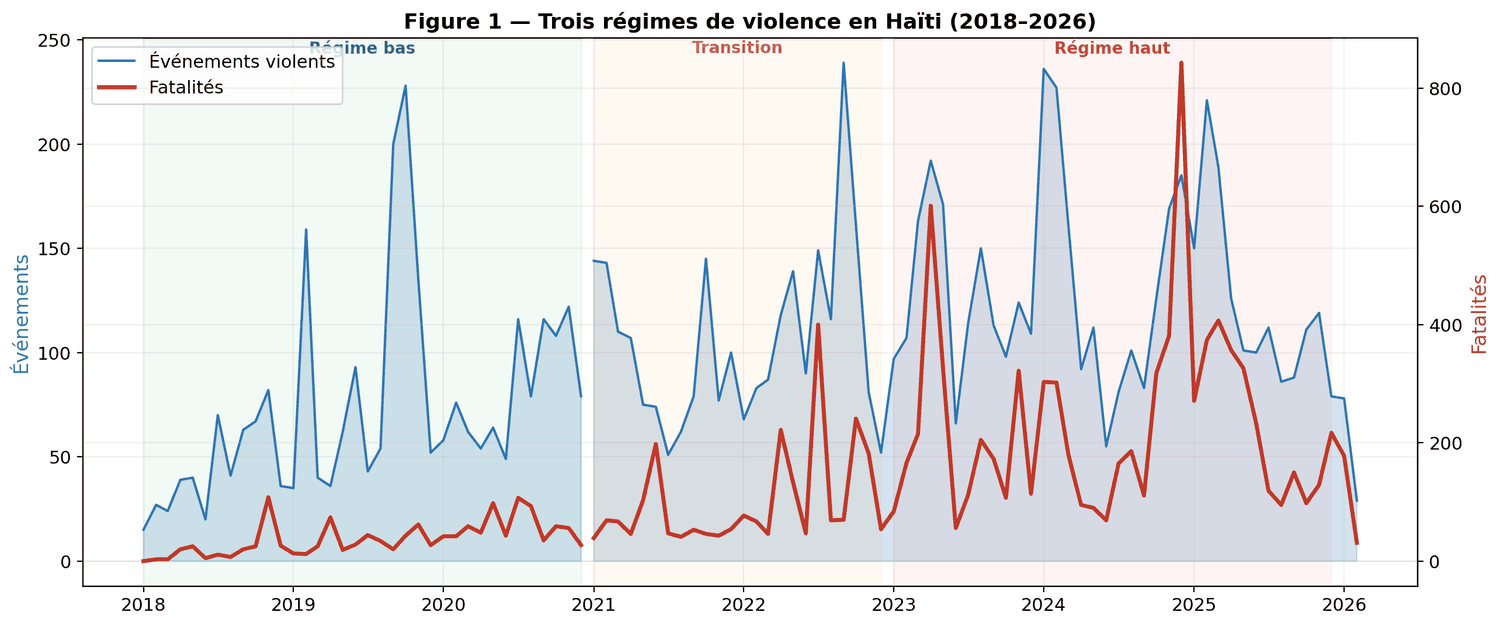
First finding. When the figures are lined up month by month from 2018 to 2026, what appears is not a gently rising curve. It is a staircase. From 2018 to 2020, the country recorded an average of 73 incidents and 38 deaths a month. That was already serious. Then, from 2021 to 2022: 106 incidents, 101 deaths. A first jump. And from 2023 onward: 124 incidents and 224 deaths a month. A second jump. Kidnappings went from 11 to 164 a month. Homicides, from 98 to 587. Each time, the system moved up a notch and never came back down.
| Period | Events | Fatalities | Homicides | Kidnappings |
|---|---|---|---|---|
| 2018 to 2020 | 73 | 38 | 98 | 11 |
| 2021 to 2022 | 106 | 101 | 158 | 84 |
| 2023 to 2025 | 124 | 224 | 587 | 164 |
Table 1. Monthly averages by period, expressed as numbers per month. Sources: ACLED for events and fatalities, BINUH for homicides and kidnappings.
Each incident kills more than before
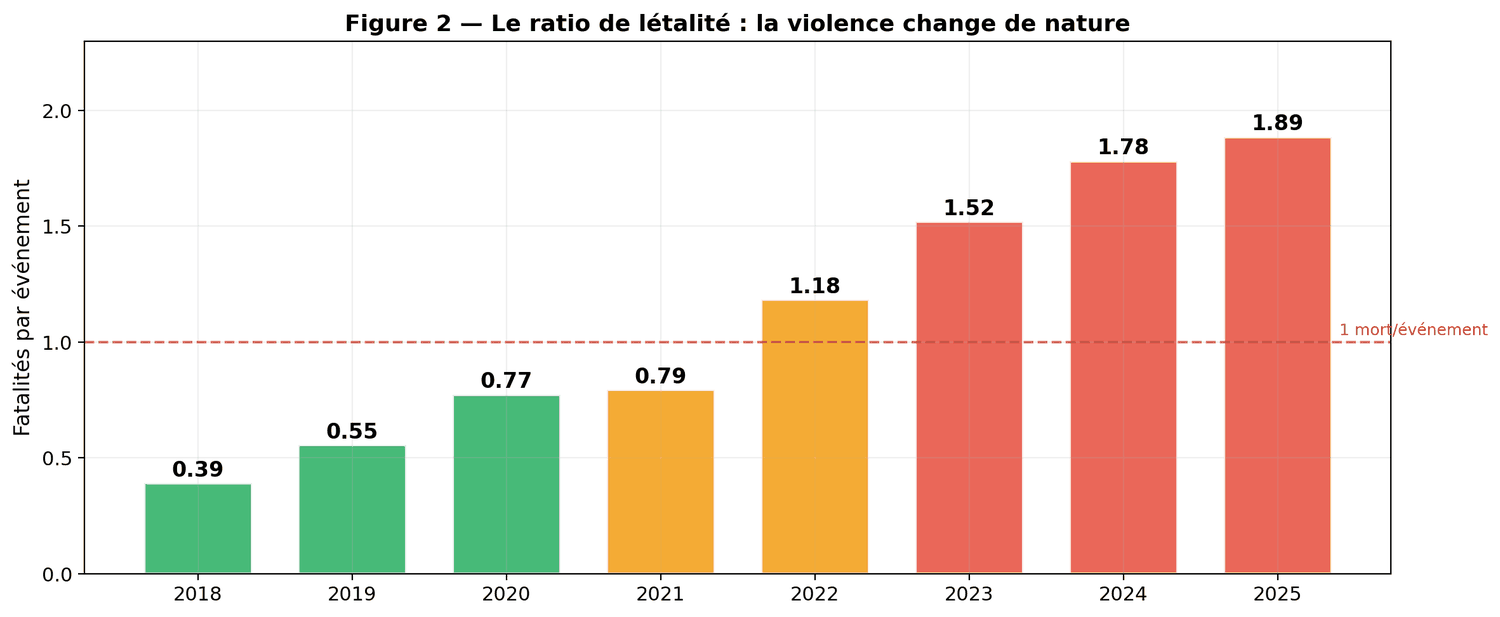
Second finding. Take the number of deaths in a month and divide it by the number of incidents. The result is the average severity of each incident. In 2018, this figure was 0.39: most incidents killed no one. It was violence, but rarely lethal. In 2022, the figure passed 1: each incident now causes at least one death on average. In 2025, it reached 1.89: nearly two deaths per incident. It is not that there are more incidents. It is that each incident has become deadlier. More weapons, more ammunition, more organization. And this change has not reversed over the period observed.
Killings do not stop. Kidnappings sometimes do
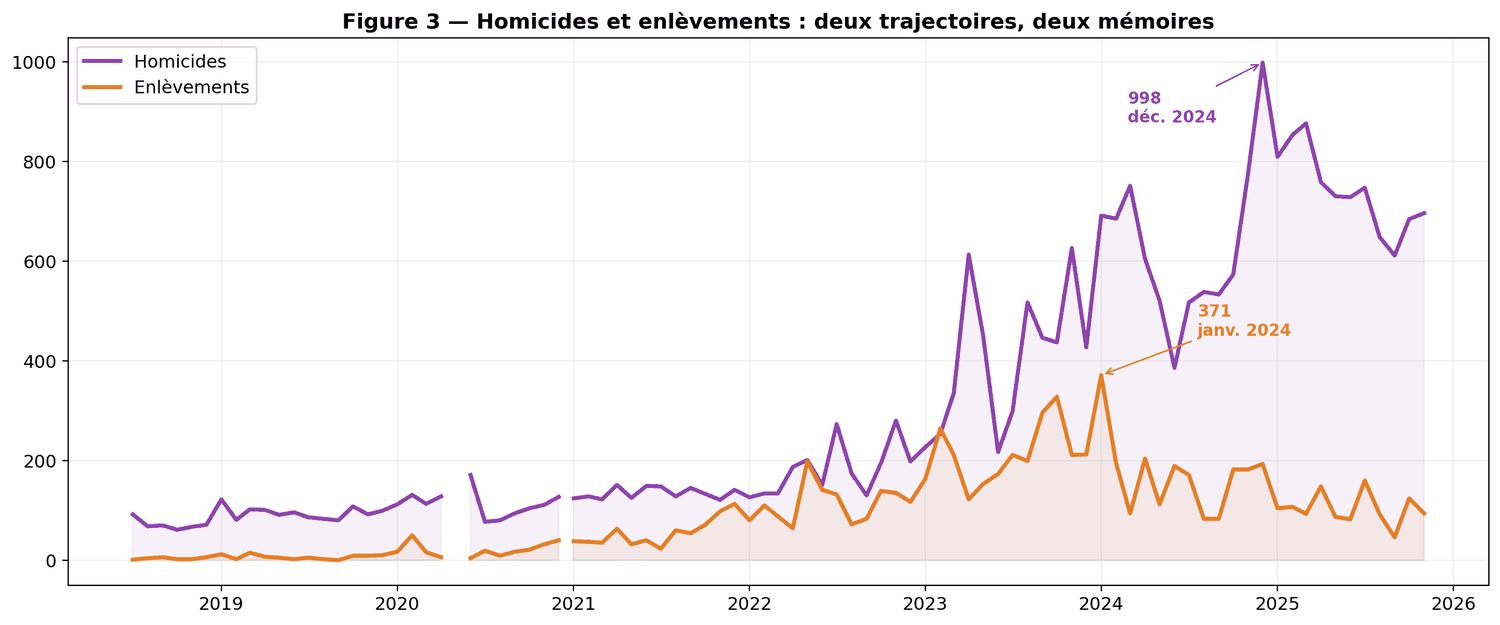
Third finding. Homicides and kidnappings do not move in the same way. Homicides have risen almost without interruption since 2019. Even in 2025, they were still climbing. Kidnappings, by contrast, exploded between 2020 and 2023, then receded. Why? Because the mechanisms are not the same. Killing is about controlling territory: when a gang moves in, killings move in with it. Kidnapping is a business: when the networks are disrupted or potential victims flee the neighborhood, kidnappings can fall. Killings are like a wall going up: once it stands, it stays. Kidnappings are like a shop: it can close if conditions change.
When violence strikes, how long does it stay?
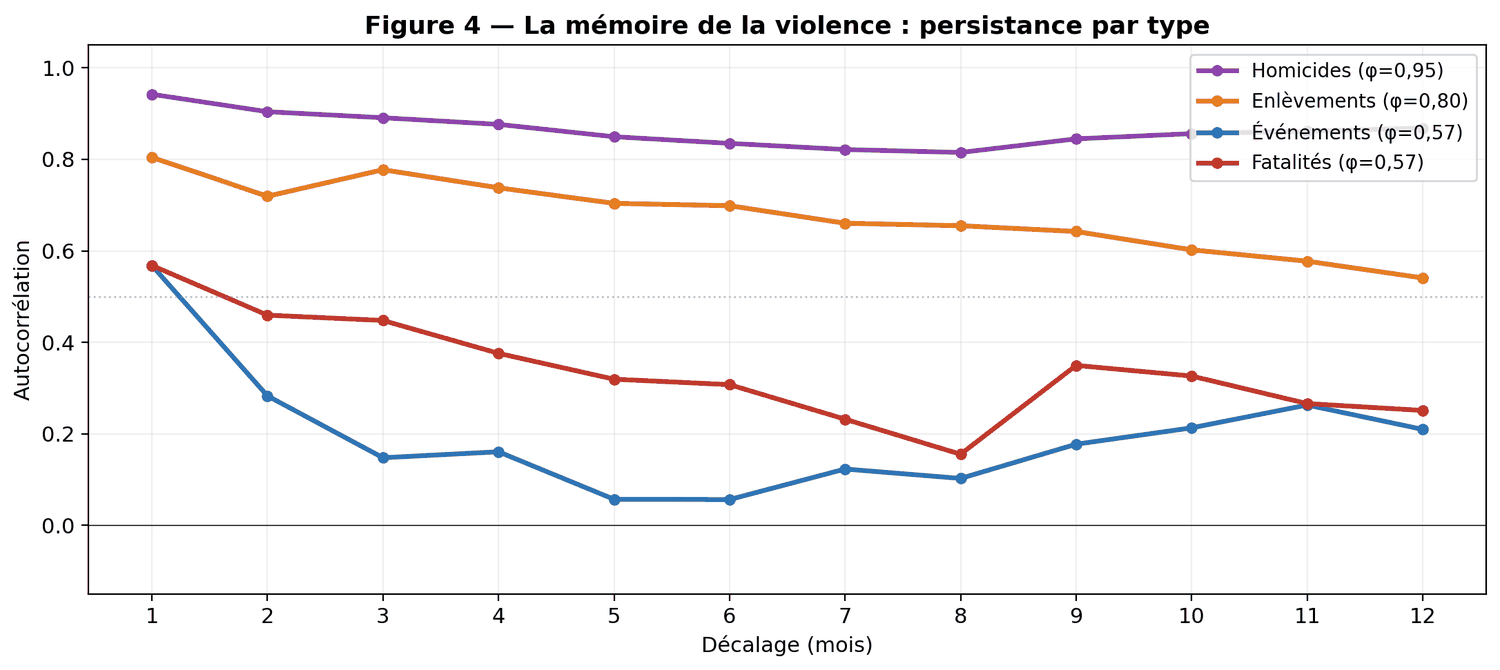
This is the most important question in this entire analysis. And to answer it, one simple concept needs to be understood: the half-life. In physics, the half-life of a radioactive element is the time it takes to lose half its strength. The same goes for violence. If a month is exceptionally violent, the half-life measures how long it takes for half of that excess violence to disappear. It is the most useful figure in this whole article, because it dictates the minimum duration of any intervention. An operation shorter than the half-life merely shifts violence in time. It comes back as soon as the pressure stops.
For armed clashes, the half-life is five weeks. If a month has 50 more incidents than usual, the following month will have only 28 more. The month after that, 16. Then 9. In five weeks, half the excess is gone. In four months, almost nothing remains. Clashes are like a flash fire: spectacular, but brief.
For kidnappings, it is much slower. If a month brings a wave of kidnappings, four-fifths of that wave recurs the following month. It takes three months for half the effect to disappear, and almost a year for it to fade completely. Why? Because kidnapping networks are not improvised. They require lookouts, drivers, ransom negotiators, safe houses. Once all that is in place, it does not stop by itself. A one-off police operation can disrupt the network, but only pressure sustained for months can dismantle it.
And homicides? This is the most frightening result. If a month has 100 more killings than usual, the following month will still have 95 more. Then 90. Then 86. It takes more than a year for half the shock to be absorbed, and nearly four years for 90% of it to fade. Clashes are a flash fire. Kidnappings are a flood that takes months to recede. Homicides are a change of climate.
The analysis also reveals the level to which the system naturally returns after each shock, if nothing changes in the country’s conditions. For kidnappings, it is 96 a month. For homicides, 442. A word of caution: these are not predictions. They are diagnoses. If the state remains this weak, if weapons keep circulating, if the criminal economy stays this profitable, then this is the level toward which violence naturally tends. It is the system’s cruising speed. Changing it takes more than one heavy blow: the conditions themselves must change.
| Type of violence | Persistence | Half-life | 90% dissipated | Equilibrium |
|---|---|---|---|---|
| Events | 57% | 1.2 months | 4 months | 102/month |
| Fatalities | 57% | 1.2 months | 4 months | 127/month |
| Kidnappings | 80% | 3.1 months | 10 months | 96/month |
| Homicides | 95% | 13.8 months | 46 months | 442/month |
Table 2. How long a shock lasts, by type of violence. Persistence is the coefficient of a first-order autoregressive model: the share of one month’s excess that recurs the following month. Author’s calculations based on ACLED and BINUH.
Between the alarm and the catastrophe, there is time
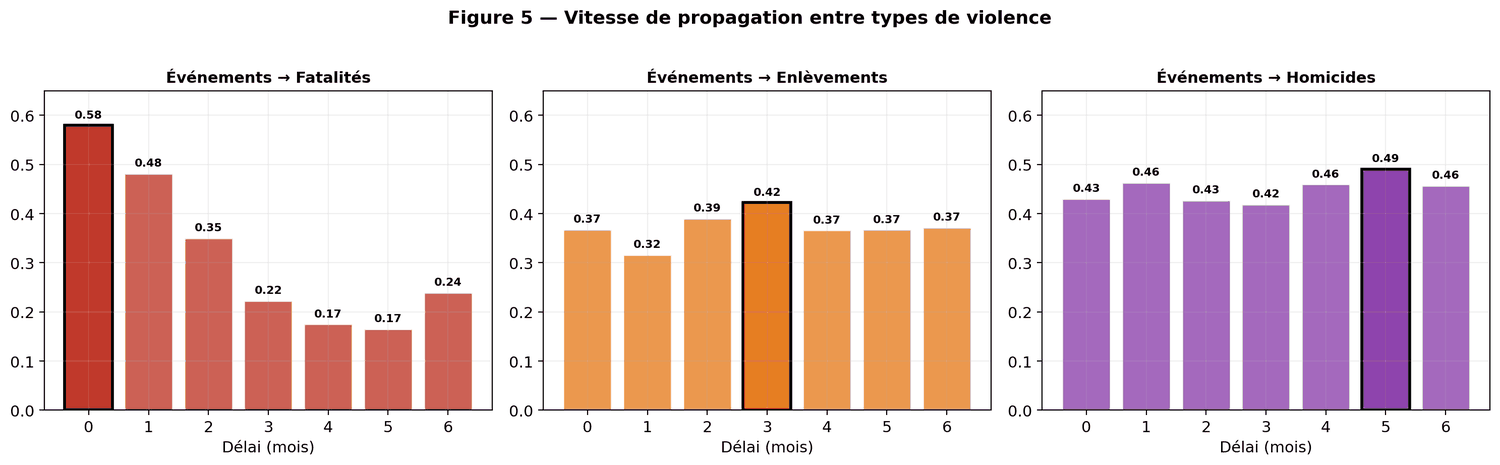
This may be the most useful result. The different forms of violence do not move at the same time. Deaths follow clashes immediately: when there is fighting, people die that same month. But kidnappings come three months later. January’s clashes predict April’s kidnappings better than they predict January’s. The explanation is concrete: fighting disrupts neighborhoods, the police pull back, residents shut themselves in, and it is in this vacuum that kidnapping networks set up shop.
Structural homicides come later still: five months after the clashes. Fighting redistributes control over areas, and it is once that control has stabilized that killings settle in for the long term. This lag is an opportunity: between a flare-up of clashes and the kidnapping crisis that follows, there are three months in which to act. Before homicides escalate, there are five. But the right indicators still have to be watched at the right time.
| Events | Fatalities | Homicides | Kidnappings | |
|---|---|---|---|---|
| Events | 1.00 | 0.58 | 0.46 | 0.39 |
| Fatalities | 1.00 | 0.74 | 0.48 | |
| Homicides | 1.00 | 0.58 | ||
| Kidnappings | 1.00 |
Table 3. Correlations among the four forms of violence. The matrix is symmetrical: only the upper half is filled in. Author’s calculations.
Where does violence come from, and where does it go?
Everything so far concerns the country as a whole, as if Haiti were a uniform bloc. It obviously is not. Violence starts somewhere, moves in one direction, and arrives elsewhere after a delay. To understand this geography is to understand the order in which to intervene, and why an operation in the wrong place can be wasted.
The Ouest department (Port-au-Prince and its communes: Delmas, Carrefour, Pétion-Ville, Cité Soleil, Croix-des-Bouquets, Tabarre, Gressier) is the generating core. This is where violence sustains itself, month after month, with no need for any outside impetus. Why? Because the rents that finance violence there are local and permanent: taxing the roads (Martissant, Carrefour, Delmas 2), control of ports and markets, well-organized kidnapping networks, formal and informal financial circuits. Violence does not come from outside: it is produced, financed, and reproduced on the spot.
The Artibonite is the first relay. Its rice-growing plain, the port of Saint-Marc, and National Route 1, which crosses it from south to north, make it a natural logistics corridor. When violence rises in the Ouest, it spreads to the Artibonite after a delay. But be careful: the Artibonite is not a passive recipient. It has its own armed history: the fighting in Gonaïves in the 2000s, control over agricultural trade, land rivalries in the Lower Artibonite, maritime smuggling through Saint-Marc. Imported violence does not fall into a void: it activates structures that are already there. The Artibonite is at once recipient, relay, and reservoir. The decisive question is when it will stop being an intermittent battleground and become a second permanent core.
The Centre department links the Ouest to the Nord and the Artibonite by inland roads. Less densely populated and less violent in absolute terms, it acts as a crossroads: controlling it alters the entire network along which violence circulates. The Sud-Est and Grand’Anse, more isolated, still enjoy a natural geographic buffer. But that buffer could give way if the corridors expand.
The most important fact is the asymmetry of transmission. Stabilizing the Ouest lowers the pressure on the Artibonite. The reverse is not true. Pacify the Artibonite without touching the Ouest, and violence rebuilds in the corridor as soon as the core sends it out again. It is like treating the symptoms of an infection while leaving its source alone: the fever can be kept down for a while, but it keeps coming back as long as the infection itself has not been cleared.
120. The number to watch
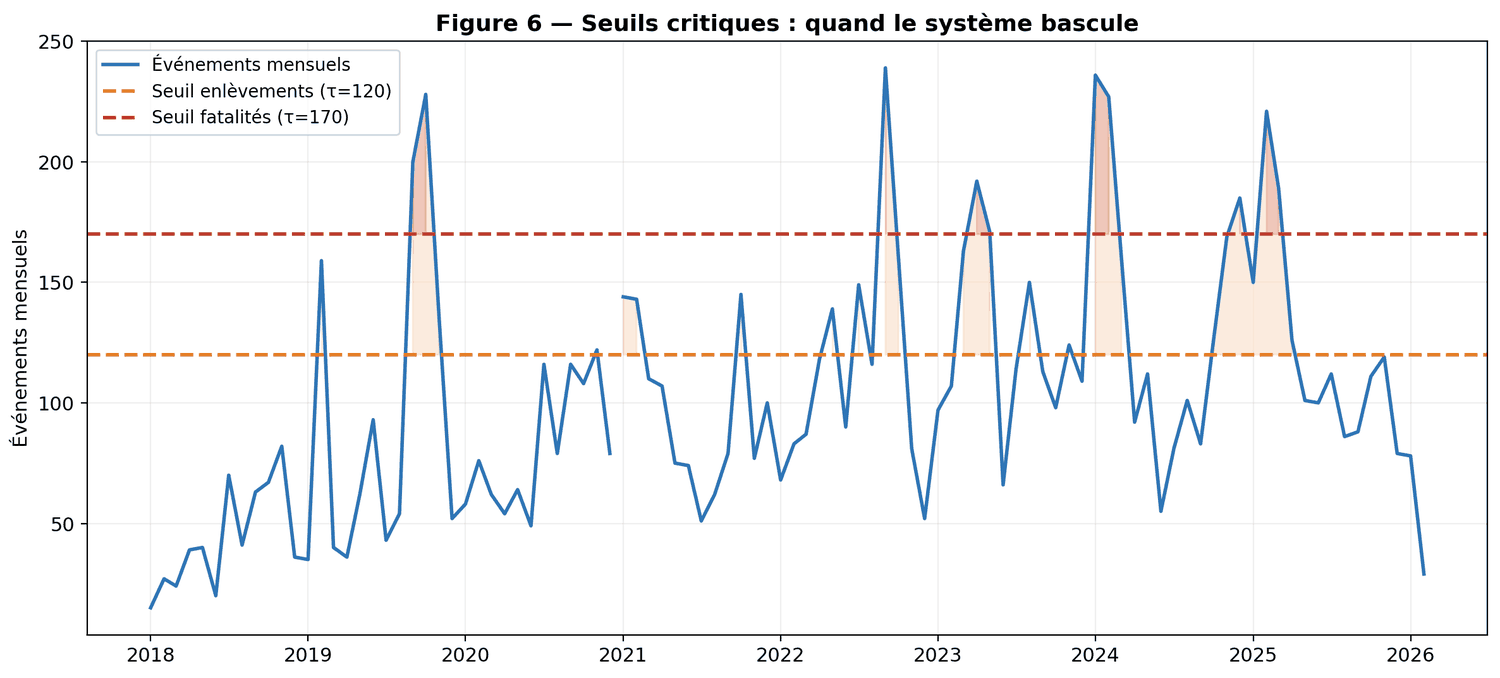
Every result in this article converges on a single number: 120. As long as the number of incidents stays below 120 a month, kidnapping networks run on inertia, but they do not spiral out of control. Once that mark is crossed, the system tips over. Kidnappings explode. And at 170 it is worse still: fatalities break away from any logic, and each month produces its own carnage, independent of the one before.
One essential point: 120 is not a goal to be reached. Nor is it a target to get below. The data count all clashes, including those that the police and security forces initiate themselves. When the Haitian National Police (PNH) or the Gang Suppression Force (GSF) launches an offensive in Cité Soleil, the incident count rises: a sign that something is happening. 120 is a warning signal. When the count crosses it, whatever the cause, we must prepare for what is coming: a wave of kidnappings within three months.
| Target | Threshold | Below | Above | What changes |
|---|---|---|---|---|
| Fatalities | 170 incidents/month | Inertial | Massive shocks | Autonomous carnage |
| Kidnappings | 120 incidents/month | Inertial | Reactive | Kidnappings explode |
Table 4. The system’s tipping points, estimated with a regime-switching model. Author’s calculations.
What the data can offer those who do the work
What follows is addressed to those who make the decisions and to those who carry them out. Police officers, soldiers, field analysts. It must be said at the outset: these figures were calculated at a desk, from statistical series. They know nothing of what it means to patrol Bel-Air at night or to negotiate a hostage’s release without backup. Haiti’s security forces operate with resources that most of the world’s armies would consider inadequate for a fraction of the threat they face. What follows does not claim to teach them their job. What follows is an attempt to translate the system’s regularities into concrete recommendations, suggesting not only the objectives but also the means of achieving them.
1. Above 120 incidents a month, prepare for the shock wave
120 is the threshold beyond which kidnappings spiral, and 170 the one at which fatalities break loose. But be careful: this is not a goal to be reached. ACLED data count all clashes, including those initiated by the PNH, the GSF, the Armed Forces of Haiti (FAd’H), and private military companies (PMCs) during their offensives against the gangs. When the security forces launch an operation in Cité Soleil or Bel-Air, the incident count goes up; that is normal, and indeed a sign that something is happening. The 120 threshold is therefore not an injunction to stop fighting. It is a warning signal: when the count goes above 120, whatever the cause, kidnappings will explode in the following three months. So as soon as the threshold is crossed, the wave of kidnappings must be anticipated: reinforce anti-kidnapping units, secure the routes used by potential targets, activate intelligence operations against the networks. The mistake would be to think that the rise in clashes is an isolated problem. It is the trigger for a cascade.
2. Keep up the pressure for at least five weeks, with staggered rotations
Clashes are the form of violence most sensitive to presence on the ground, but also the quickest to come back. The half-life is 1.2 months. In practical terms, this means handovers between units must be organized so that there is never a gap, however brief. A battalion that leaves on a Friday and another that arrives on a Monday leave two days in which the ground is empty. Two days are enough for the barricades to go back up and the tolls to resume. Rotations must be simultaneous, not sequential: the incoming unit must be operational before the outgoing unit leaves the area.
3. Against kidnappings: three months of dual pressure, territorial and financial
The half-life of kidnappings is 3.1 months. The networks are organized like businesses, with replaceable lookouts and irreplaceable negotiators. Arresting lookouts achieves nothing: they are replaced within 48 hours. What dismantles a network is striking simultaneously at its logistics (territorial control of identified safe houses, blocking of transport vehicles) and at its financial nodes (negotiators’ accounts, ransom-laundering channels, complicit money-transfer agents). One without the other does not work: territorial control without intelligence is occupation; intelligence without territorial control is useless knowledge. The two together, kept up relentlessly for three months, begin to make a dent in the structure.
4. Against homicides: force alone is not enough
Each month, 95% of homicidal violence reproduces itself through inertia. The half-life is 14 months. No six-month military operation will alter that curve. What alters it is a change in local conditions. A permanent police station in a gang-controlled neighborhood changes the calculation. An accessible justice of the peace changes how disputes are settled. A credible jobs program changes the opportunity cost of armed recruitment. Military force creates the space, but if that space is not immediately filled by civilian institutions, the killings resume as surely as a river fills a hole. This requires civil-military coordination that does not yet exist at the necessary scale, and it would be dishonest to claim otherwise.
5. Mobilize anti-kidnapping units as soon as clashes rise
When fighting flares up in January, kidnappings will follow in April and homicides in June. This is a measured fact. Specialized anti-kidnapping units should not wait to see kidnappings rise before deploying: they should deploy as soon as the clash count rises above its moving average. In practice, this requires a dashboard shared in real time among field units, intelligence analysts, and decision-makers. That information-sharing is currently held back by the lack of secure communications and by compartmentalization between agencies. Improving this flow costs far less than an additional battalion, and its strategic return is potentially higher.
6. Sequence the territory: the Ouest first, then the Artibonite corridor
The data show that Port-au-Prince is the generating core and the Artibonite the relay. Stabilizing the Ouest lowers the pressure on the Artibonite; the reverse does not hold. In practice: first secure the corridors of Port-au-Prince (Delmas, Route de Frères, the Carrefour axis), then extend toward National Route 1 and the Artibonite plain. This does not mean abandoning the Artibonite in the meantime: it means that gains made there will remain fragile as long as the core has not been dealt with. If resources force a choice, the highest return lies in the core.
None of the above is easy to implement. Manpower is insufficient, equipment is lacking, coordination among the PNH, the FAd’H, the PMCs, and the GSF remains imperfect, and field intelligence depends on the trust of populations that do not always have reasons to grant it. The model resolves none of these constraints. But it does make it possible to avoid adding a calibration error to all these difficulties. That is the least the numbers can offer those who do the hardest job in the country.
Conclusion
For years, Haitian violence has been described as chaos. As fate. Something one endures, deplores, flees, but does not understand. That account is false. Not because the suffering it describes is exaggerated, but because the word “chaos” destroys any possibility of action. If violence has no logic, there is nothing to understand. If there is nothing to understand, there is nothing to be done. And if there is nothing to be done, then one is entitled not to try anything.
This analysis shows that it is false. Haitian violence has a structure. It advances in steps, not along a gentle slope. It persists for a longer or shorter time depending on its form: clashes are a flash fire, kidnappings a flood, homicides a change of climate. It spreads from one type to another with measurable lags: three months between fighting and kidnappings, five months between fighting and killings. It tips over beyond identified thresholds: 120 events a month for kidnappings, 170 for fatalities. And it moves across the territory asymmetrically, with a generating core, the Ouest, and an amplifying corridor, the Artibonite.
None of this was visible to the naked eye. It took 98 months of data, autoregressive models, thresholds estimated by systematic search, and lagged cross-correlations to see it. But once it has been seen, no one can go on pretending not to see it.
A great deal remains to be done. The data say nothing about the individual paths that lead a teenager from Cité Soleil to take up arms. They say nothing about the arrangements between political elites and gang leaders that make certain territories untouchable. They do not predict the next massacre, and they will never say what must be done. They set constraints within which political decisions can at last be made on the basis of something other than intuition and urgency.
Haitian violence is a system. It has durations, thresholds, lags, a center and a periphery. We now know its parameters. That does not guarantee that it can be defeated. But it removes, once and for all, the right to say that we could not have known.
Methodological note
This analysis rests on 98 monthly observations, from January 2018 to February 2026. Incidents and fatalities come from ACLED; homicides and kidnappings from BINUH. The duration of shocks is measured with a model that links each month’s violence to that of the previous month (an autoregressive model). Tipping thresholds are identified with a regime-switching model (TAR). Propagation lags are measured by correlations between time-shifted series.