Unfolding the Crisis: What Geometry Teaches the Haitian Economy
Translated from the French original. In case of discrepancy, the French text prevails. Read the French original
A Haitian mathematician, Ruben Louis, studies how to open up the points where the ordinary tools of geometry stop working. His results offer the country’s economists a method for reading an economy that standard models can no longer describe, and a reason to make mathematics a matter of public policy.

Ruben Louis is Haitian, a mathematician, and he publishes in journals that almost no economist will ever open. The objects he studies carry names that make readers close the page: Lie algebroids, singular foliations, the Nash blowup. The reflex is to conclude that none of this concerns us. I believe the opposite. In a very pure language, this work poses the question that the Haitian economy puts to us every day: what do you do when the ordinary tool stops working precisely at the point you care about?
The argument proceeds in four steps. It first recalls that all marginal reasoning in economics is, tacitly, a geometer’s reasoning. It then defines the singular point and shows how Haiti bears its features. It sets out Nash’s idea, which is not to run away from that point but to open it up. Finally, it translates two related notions, the leaf and the anchor, before proposing three projects to those who are twenty-five and have an economics degree in their pocket.
The economist, an unwitting geometer
Take any sentence from the trade. “A one-point rise in the policy rate reduces credit by so much.” “The elasticity of imports to the exchange rate is such and such.” “The marginal propensity to consume is 0.8.” Each of these sentences asserts the same thing: around the point where the economy sits, the relationship between two quantities looks like a straight line, and its slope can be measured.
That is precisely the definition of a smooth curve. A curve is smooth when, if you zoom in far enough on one of its points, it ends up indistinguishable from a straight line, its tangent. For a surface, zooming in gives a plane, the tangent plane. The derivative, the elasticity, the multiplier are all tangents. The whole of marginal analysis rests on the unspoken assumption that the zoom works.
Economists have looked this assumption in the face once before. In 1970, Gérard Debreu published an article in Econometrica that distinguished “regular” economies, in which equilibria are finite in number and respond in a well-behaved way to small shocks, from “critical” economies, where that good behavior is lost. His tool came from differential topology. The conclusion was reassuring: critical economies are rare, carrying negligible weight in the set of all possible economies. The profession drew from it a lasting permission: to concern itself only with the regular case.
Rare does not mean nonexistent. And when you live in the rare case, the permission is worth nothing.
The point where the zoom fails
A singular point is a point where zooming in no longer yields a single straight line. There, the curve has a fold, a cusp, or a crossing. You can zoom as much as you like: the fold remains a fold. The tangent is not hard to compute there; it does not exist.
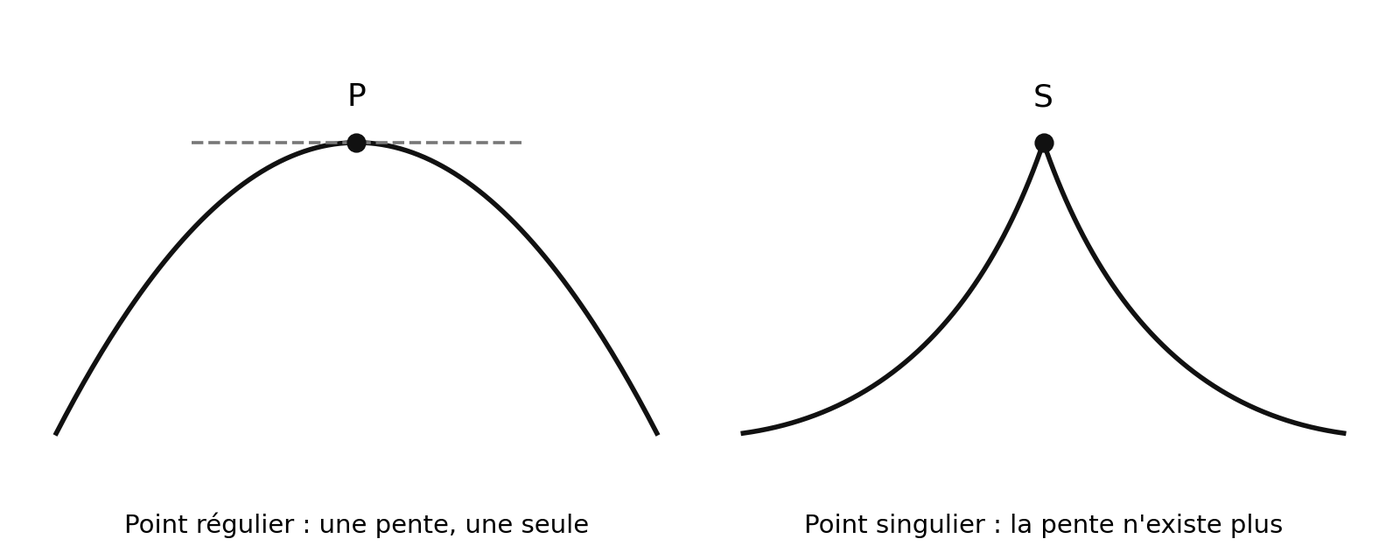
Let us translate. To say that an economy sits at a singular point is to say that the question “what is the marginal effect of this measure?” has no single answer, because the answer depends on the side from which you approach.
Haiti bears those marks, and they come with dates. Real GDP shrank for the seventh year in a row in 2025, by 2.7%, with declines in every sector. Seven years running is no longer a cycle around a trend; it is a trajectory that has left the zone where business-cycle models make sense. Government revenue has fallen to 4.8% of GDP: at that level, the elasticity of revenue to activity, which elsewhere is estimated as a matter of routine, changes in nature depending on whether the activity lies in a zone where the state still collects or in one where it no longer collects anything. More than 1.4 million internally displaced people were recorded in September 2025, three times as many as in December 2023. The IMF, for its part, notes that financial intermediation continues to weaken, which means that the channel through which a policy rate is supposed to work is narrowing before our eyes.
Under these conditions, estimating “the” Haitian fiscal multiplier or “the” transmission of monetary policy amounts to looking for the tangent at the apex of the fold. You will get a number; the software always returns one. That number will be an average of slopes that have nothing to do with one another, and it will describe nothing real.
What Nash proposes to do with a broken point
The idea bears the name of John Nash, the same Nash who gave economists their notion of equilibrium. It is surprisingly simple.
The point S is singular, but the points around it are perfectly regular. Each has its tangent. So let a sequence of regular points approach S, and watch what becomes of their tangents. They converge to a limiting position. The catch is that the limit depends on the path of approach. Coming from the left of the fold, you get one line; from the right, another.
Nash proposes replacing the point S with the set of all these limits. Where there was a single, unreadable point, you install as many points as there are ways of getting there. Each of these new points carries its own tangent, well defined. That is the Nash blowup: you do not repair the singularity, you unfold it.
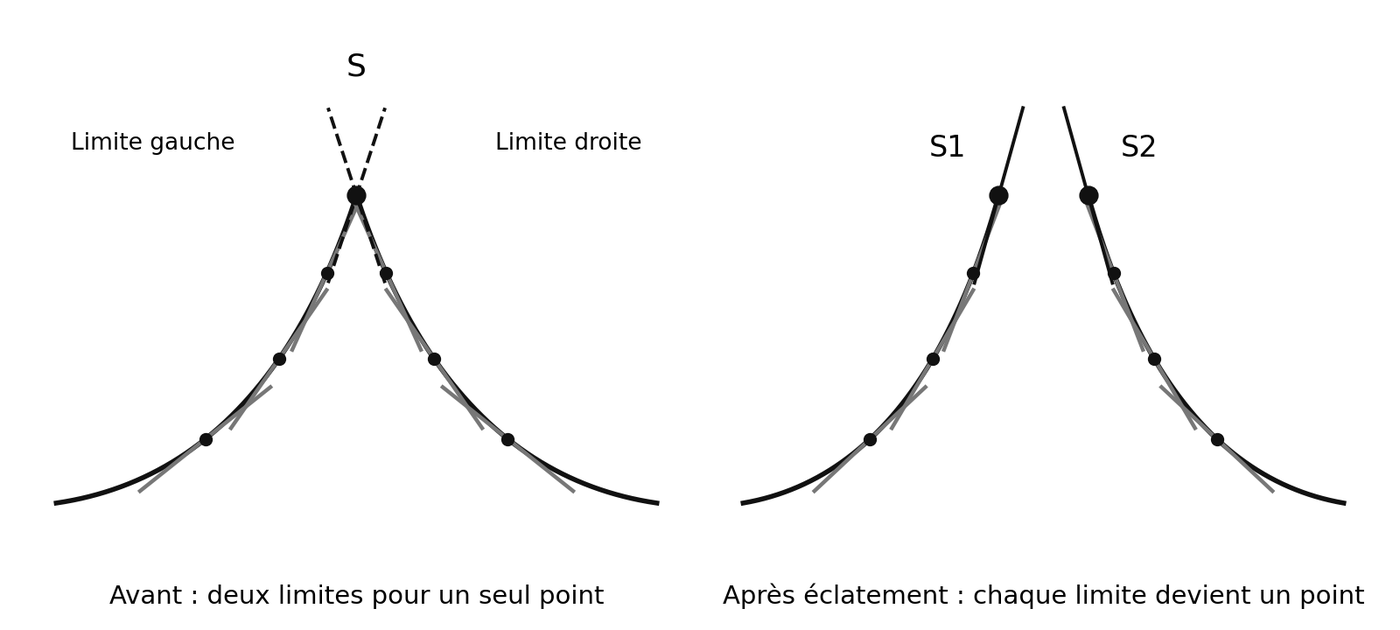
For the economist, the lesson is a rule of method. Faced with a singular economy, stop asking for a parameter and start asking for a family of parameters, indexed by the paths of approach. What is the response of credit to the policy rate in Pétion-Ville’s formal banking segment? In the credit unions of the North? In the neighborhoods where no bank branch opens anymore? What was it in 2018, before the run of contractions, and what is it worth today? Each of these questions has its own answer, one that can be estimated, because it concerns a regular zone. The collection of these answers, not their average, is the correct description of the country.
Econometrics already has tools that point in this direction: threshold models, regime-switching models, quantile regressions. They are most often used as refinements, to check the robustness of a central result. The geometry of singularities says something else: in the singular case, there is no central result, and these tools become the analysis itself.
Leaves you can move along, and leaves where movement has stopped
The second notion is the foliation. A foliation divides a space into subspaces called leaves, in such a way that every permitted movement takes place within a leaf. A mille-feuille gives the picture: you slide along one layer; you do not jump from one layer to the next. In a regular foliation, all the leaves have the same dimension, that is, the same number of directions of movement. A foliation is singular when that dimension varies from one leaf to another. The classic example is the rotation of the plane around a center: every point turns on its circle, a leaf of dimension one, except the center, which goes nowhere, a leaf of dimension zero.
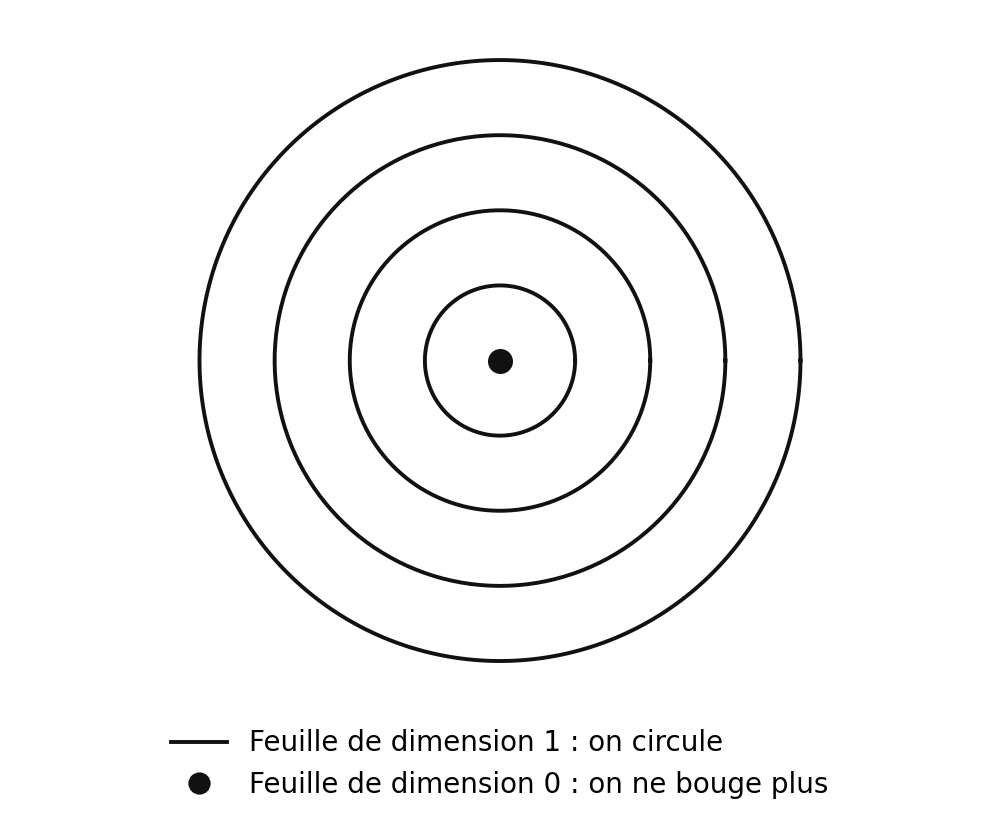
Now let us read an economy as a foliation. An agent’s leaf is the set of situations reachable through the agent’s own decisions: switching suppliers, moving goods, borrowing, converting gourdes, sending a child to school somewhere else. The dimension of the leaf is the number of these options that are actually open. Textbooks assume a regular foliation: all agents have the same directions of movement; only their budgets differ.
Haiti is a singular foliation in the strict sense of the term. A formal firm in the metropolitan area, banked, dollarized, connected to the port, lives on a high-dimensional leaf. A market woman whose supply route has been cut, who has neither an account nor access to credit, lives on a leaf shrunk almost to a point. The 1.4 million displaced people have not only lost income; they have lost dimensions. And this is where the concept becomes useful: a policy that acts along the leaves (a rate cut, a subsidy, a tax exemption) has no effect on a leaf of dimension zero, since the agent has no direction in which to respond. Many measures judged “ineffective” in Haiti are not badly designed. They are designed for leaves that half the agents do not inhabit.
Poverty measured in gourdes per day captures the position on the leaf. Nobody measures the dimension of the leaf.
The engine runs, the car stays put
That leaves the Lie algebroid. The word is intimidating; the idea fits inside a car.
Sitting at the wheel, you have commands at your disposal: steer, accelerate, brake, reverse. First observation, one that every child has made without putting it into words: order matters. Driving forward ten meters and then turning left does not take you to the same place as turning left and then driving forward ten meters. A Lie algebra is that and nothing more: the list of available commands, together with a rule that measures the gap between “do A, then B” and “do B, then A.”
Second observation. The commands do not respond the same way everywhere. On dry asphalt, every turn of the wheel turns the car. In mud, you turn the wheel and the car keeps going straight. In a rut, you accelerate and the wheels spin. The dashboard is the same, but what it allows changes with where you are. A Lie algebroid is a dashboard of this kind: a set of commands attached to each point of the terrain, and varying with the terrain.
The third piece, and the most important: what connects the command to the wheel. In a car, that is the clutch and the transmission. Mathematicians call it the anchor: the mechanism that turns a command into actual movement. When the clutch is worn, the engine roars, the gas burns, the tachometer needle climbs, and the car stays where it is. Everything works except the link to the ground. This activity that spins without moving anything has a name: the kernel of the anchor. At singular points, it grows: more and more commands, less and less movement.
The result Ruben Louis published in Mathematische Zeitschrift in 2025 comes down to this. At the singular point, what slips and what drives are tangled together, and you can no longer tell which part does what. After a Nash-type blowup, the hood opens and the parts sort themselves into two separate boxes. In the first, everything that spins on itself without touching the wheels. In the second, everything that truly drives, where, almost everywhere, one turn of the engine gives one turn of the wheel. The author himself poses the question: can one separate, in an algebroid, the purely internal part from the part that acts on the terrain? Once the point is unfolded, yes.
Now replace the car with the state. This is a transposition, not a theorem of economics, but it sheds light. The commands are the policy rate, the approved budget, the customs tariff, the decree. The anchor is everything that connects these commands to the ground: the banks that pass on the rate, the treasury officials who disburse, the customs officers who collect, the road by which the decision arrives.
The central bank turns the steering wheel of the policy rate. Where bank credit irrigates activity, the economy turns. Where nobody borrows from a bank, the wheel turns in a void. An approved budget is a command; the sum actually disbursed in a municipality is a movement; between the two lies the clutch. The customs tariff exists on paper at every point along the border; revenue exists only where the state holds the border post. Government revenue that has fallen to 4.8% of GDP is the accounting measure of a slipping clutch.
And order matters, just as it does at the wheel. Reopen a road, then subsidize fertilizer: the fertilizer reaches the field. Subsidize first, reopen later: the subsidy is lost along the way before the road even exists. Same measures, same cost, different result. The gap between the two orderings is what mathematicians call the Lie bracket. Economists call it the sequencing of reforms and usually treat it as a matter of common sense, when in fact it has a structure that can be studied.
Hence a discipline of analysis in two boxes. For each institution, put on one side whatever spins on itself: circulars, committees, plans, revisions of plans, all consistent with one another, with no effect on the ground. On the other, whatever moves something: revenue collected, a loan disbursed, a container cleared through customs, a road reopened. Then judge a reform by the second box alone. A country can produce a great many decisions and very little movement. The noise of the engine has never been proof of speed.
Three projects for anyone who is twenty-five
The first is econometric. Take the main relationships of Haitian macroeconomics (monetary transmission, revenue elasticity, the effect of diaspora remittances on consumption) and estimate them by path of approach: by territory, by segment, by period, treating the dispersion of the results as the result. Data from the Bank of the Republic of Haiti (BRH), the central bank, from the Haitian Institute of Statistics and Informatics (IHSI), and from household surveys make this partly possible. An undergraduate thesis could take it on.
The second is a measurement exercise. Build an indicator of leaf dimension: for a household or a firm, how many options are actually open? Physical access to a market, a bank branch, a passable road, a second currency, a second supplier. Such an indicator would show in advance where an incentive policy can bite and where dimensions must first be reopened, which is an entirely different kind of spending.
The third is institutional, and more modest than it looks. A joint seminar of Haitian mathematicians and economists, at home or in the diaspora, where the former would present their objects without simplifying anything and the latter would bring their data. Debreu did not invent differential topology; he went and got it from the people who were doing it. In 1974, Zeeman made the opposite journey, applying René Thom’s catastrophe theory to stock market crashes. Such crossings have always been the work of a few people who were willing not to understand everything for a year or two.
Out of the register of miracles
Regular economies are those where the simple tool suffices, because the tangent exists there and any regression will find it. It is the singular cases that demand the finest mathematics, for the very concrete reason that the linear approximation is wrong there. A country sitting on the fold therefore needs mathematicians more than a prosperous country does, and it is the one that makes the least room for them. Correcting this is a matter of policy, not of individual vocation.
That policy begins in school. Mathematics is taught there as recitation, formulas to be reproduced on the day of the baccalaureate exam, without students ever having had to use them to describe something they know: the price of rice at the market from one week to the next, the flow of a ravine after rain, the speed at which a rumor crosses a neighborhood. Introducing modeling in secondary school, training teachers at the École normale supérieure to teach it, setting up national competitions that give the best students a reason to stay in the discipline: none of this costs as much as a generation that regards mathematics as an ordeal rather than a language.
Next, there has to be a place. Brazil founded its Institute for Pure and Applied Mathematics in 1952, when it was a poor, agrarian country; in 2014, Artur Avila, a mathematician who had written his doctoral thesis there, received the Fields Medal. The African Institute for Mathematical Sciences, opened in Cape Town in 2003, has since spread to Senegal, Ghana, Cameroon, and Rwanda, among others. Haiti can build a version on its own scale: a Haitian Institute of Applied Mathematics attached to the university, a dozen permanent researchers, visiting chairs for diaspora mathematicians, a master’s program, and jointly supervised doctoral theses. With one founding rule: every research program is tied to a national question, be it the currency, floods, epidemics, energy grids, or population displacement.
An institute on its own would publish for audiences abroad. It needs channels into decision-making. The central bank and the ministries of Finance, the Environment, and Health should commission studies from it. Every budget law and every major reform should come with a published, quantified impact assessment that the institute can review independently. Data from the IHSI and from government agencies should be open to researchers. Young PhDs should spend a year in residence in a ministry, and ministry officials a year at the institute. It is through these ordinary pipes that a result leaves the journal and becomes part of a policy choice.
That leaves the hardest part, which is neither budgetary nor academic. In Haitian public discourse, inflation is a curse, security a miracle to be awaited, recovery the business of a providential man or of a force from abroad. This register has its dignity in each person’s private life. Applied to the affairs of state, it is a form of torpor: it excuses us from looking for the mechanism, hence from naming the decision that produced it, hence from demanding a different one. Mathematics, in this precise domain, is the exact opposite. It trains us to ask how much, relative to what, through what chain of causes, and to treat a claim as false until it has been proven. A people that has acquired this habit is less easily governed by fatalism.
That a Haitian is working at the frontier of the geometry of singularities proves that the raw material exists. What remains is to decide to make it a policy. Knowing what becomes of a slope as you approach the fold is knowing which question to ask. Building the places where that question will be asked every day is how you begin to leave the fold.