MINUSTAH Knew, the State Never Received the Data
First published in Le Nouvelliste on 11 December 2025. Read on lenouvelliste.com ↗
Translated from the French original. In case of discrepancy, the French text prevails. Read the French original
When they left Haiti on 15 October 2017, the UN peacekeepers took thirteen years of strategic memory with them: crime mapping updated every week, files on gang leaders, analyses of financial flows, doctrines tested in the field. Nothing was handed over, not because it was withheld, but because there was no institution in a position to receive it.
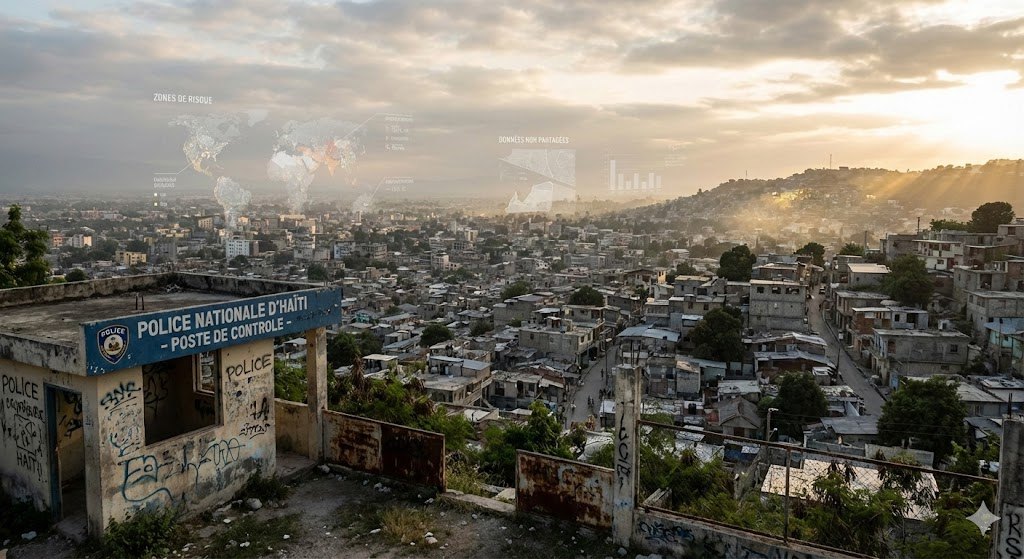
When the peacekeepers left Haiti on 15 October 2017, they took far more than containers, vehicles, and uniforms with them. They left with a complete strategic memory, patiently built up over thirteen years: crime maps updated several times a week, detailed files on gang leaders, analyses of financial flows, operational doctrines tested in the field. An intelligence architecture that never found a taker. Not because it was withheld, but because nothing was ready to receive it.
That is what the International Peace Institute notes in its report on the transition that followed the United Nations Stabilization Mission in Haiti (MINUSTAH): the mission left “without a clear plan for transferring capabilities,” at a time when no Haitian body was in a position to absorb, secure, or exploit these data (IPI, 2018). You do not hand over an intelligence base to an empty administrative space. And yet that is exactly what happened.
In the years when MINUSTAH was fighting the gangs, the heart of the mission was not the armored vehicles, nor the patrols, nor the checkpoints. It was a small unit: the Joint Mission Analysis Centre. The JMAC fused patrol reports, human sources, satellite imagery, and discreet observation in the field. It produced complete files: the leaders’ habits, their movements, their go-betweens, their safe havens, their sources of cash. In 2007, it was this work that made it possible to arrest Zachari, then Ti Bazile, Evens Jeune, Belony, Ti Will. Nothing spectacular. Just meticulous intelligence.
After the 2010 earthquake, this machine became even more refined. The maps produced at the time (population density, informal checkpoints, criminal mobility corridors) already foreshadowed the boundaries of armed power in 2020 or 2025. Those who consulted these documents stress how visible the current fragmentation of Port-au-Prince already was in the GIS layers that the mission updated every week (Security Council Report, 2017). MINUSTAH could see what would unfold next.
But no Haitian institution received this knowledge. No body inherited the maps, the methods, or the protocols. The International Organisation of La Francophonie (OIF), in its note on the post-MINUSTAH period, points out that the mission left a country where “no lasting national structure had been put in place to guarantee the continuity of capabilities” (OIF, 2022). It is not that the state forgot. It is that nothing was ever handed to it.
Meanwhile, the gangs were evolving. In the absence of structured surveillance, they were free to transform themselves. They armed themselves to an unprecedented degree. In 2007, they mostly had pistols and homemade rifles. In 2025, the country has between 270,000 and 500,000 firearms according to Robert Muggah, a considerable share of them controlled by criminal groups: AR-15s, AK-47s, .50-caliber sniper rifles, military-grade ammunition coming mainly from Florida. Their firepower sometimes exceeds that of the police.
They federated. Instead of a multitude of small gangs, Haiti now faces large coalitions: the G9, the G-Pèp, Viv Ansanm. Several thousand organized fighters, controlling nearly 80% of the capital according to UN estimates. A degree of coordination that MINUSTAH had never encountered on this scale.
They built diversified economies. Kidnapping, fuel, markets, roads, money transfers. As Robert Fatton shows, these groups are no longer mere predators: they have become actors that capture rents, structure territories, and impose rules. They embody what the literature calls “criminal governance”: a parallel authority, with its own taxation, its own justice, its own informal police.
They found a voice. Publicly. Cameras, ultimatums, speeches. In 2024, a criminal alliance can force a prime minister to resign and shut down an airport. This is a political mutation, no longer simply a criminal one.
While the gangs were growing in strength, the state was groping in the dark. No monitoring tools, no data, no doctrine. After MINUSTAH left, nothing was put in place to take over. Police stations abandoned, vehicles out of service, communications down. The police fell back on one-off interventions, brief and without continuity: exactly the model that Kalyvas identifies as the most conducive to violence taking root.
It was not a moral failure. It was a structural failure. To hand something on, you need a receptacle. To inherit, you need an institution. Haiti had neither.
Yet MINUSTAH had understood something essential: you do not stabilize an area with an operation, but with a presence. “Clear, hold, build.” A patient logic that combines intelligence, holding the ground, and reconstruction. This knowledge exists. It has been tested. But in 2017, no one was in a position to keep it alive after the mission left.
In 2025, the Gang Suppression Force (GSF) arrives. With its analysts, its maps, its doctrines. A new memory is building up. A new machine is starting up. Nothing guarantees that it will succeed, but its analytical capacity will be real. That, however, is not the question. The question lies elsewhere: what will remain when it leaves?
If a national unit is not created now to receive what the GSF will discover, history will repeat itself. As in 2017. As in 2004. A mission arrives, understands, acts, leaves, and the country is left alone, with a void heavier than before.
But there is nothing inevitable about this. Other nations have managed to turn international assistance into lasting capacity. Colombia absorbed American methods to the point of making them its own doctrine. El Salvador institutionalized post-conflict analysis. Foreign knowledge is not meant to remain foreign: it is meant to become local.
And that is where the future will be decided. Not in a decisive battle against an armed group. Not in a spectacular intervention. But in the creation, at the heart of the state, of a space where knowledge is no longer lost. Where international missions no longer leave with what they have learned. Where memory becomes a continuity and not a parenthesis.
What comes next can mark a break. The GSF will not stay forever. But its departure need not open up a chasm. It can be a threshold. A passage. The first time Haiti decides that the knowledge produced on its territory belongs to it. The first time a foreign architecture becomes a national capacity.
Nothing obliges the country to repeat the scenario of 2017. Nothing prevents it from inventing a different future. History is never written in advance. It waits for someone to take it seriously.
The real question is simple: this time, will Haiti decide to keep the memory?